
Researchers have shown how to write any desired magnetic pattern onto nanowires, which could help computers mimic how the brain processes information.
Many current computer hardware devices, such as hard drives, use magnetic memory devices. These rely on magnetic states — the direction microscopic magnets are pointing — to encode and read information.
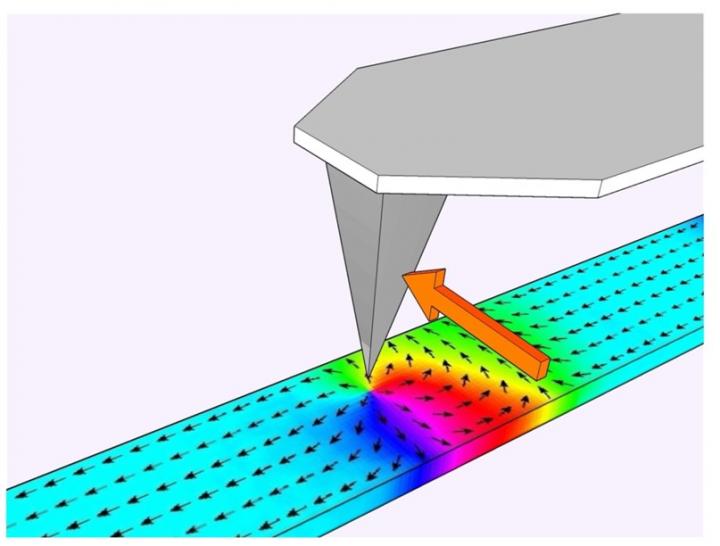 Illustration of the atomic force microscope tip writing a nanowire. Source: Gartside et al/Imperial College London
Exotic magnetic states, like a point where three south poles meet, represent complex systems. These may act in a similar way to many complex systems found in nature, like the way our brains process information.
Computing systems that are designed to process information in similar ways to our brains are known as neural networks. There are already powerful software-based neural networks. For example, Google's DeepMind recently beat the human champion at the game Go. But their efficiency is limited as they run on conventional computer hardware.
Researchers from Imperial College London have devised a method for writing magnetic information in any pattern desired, using a very small magnetic probe called a magnetic force microscope. With the new writing method, arrays of magnetic nanowires might be able to function as hardware neural networks. This potentially could be more powerful and efficient than software-based approaches.
The team, from the Departments of Physics and Materials at Imperial, demonstrated their system by writing patterns that have never been seen before.
Physics professor Dr. Jack Gartside said, "With this new writing method, we open up research into 'training' these magnetic nanowires to solve useful problems. If successful, this will bring hardware neural networks a step closer to reality."
As well as applications in computing, the method could be used to study fundamental aspects of complex systems by creating magnetic states that are far from optimal and seeing how the system responds.
A paper was published in Nature Nanotechnology and it can be accessed here.
