
Today's cars are loaded with electronics, to the delight of some and the chagrin of others. Regardless of your view on this situation, or how you listen to music, news, weather or sports in the vehicle, the venerable AM-band radio is still a standard mainstay in the automobile (although in a few years, that may no longer be the case).
The problem with the AM radio in the car is two-fold: AM as a modulation scheme is inherently sensitive to electrical noise while the switching electronics of today's cars (DC/DC power converters, motor drivers, digital electronics, engine controls – it's a very long list) makes the car a very hostile place from an EMI perspective. At the same time, all the digital infotainment and ADAS (Advanced Driver Assistance Systems) functions inherently have noise-sensitive analog sensors and transducers; and the AM radio and its audio channel are both a potential source and victim of noise.
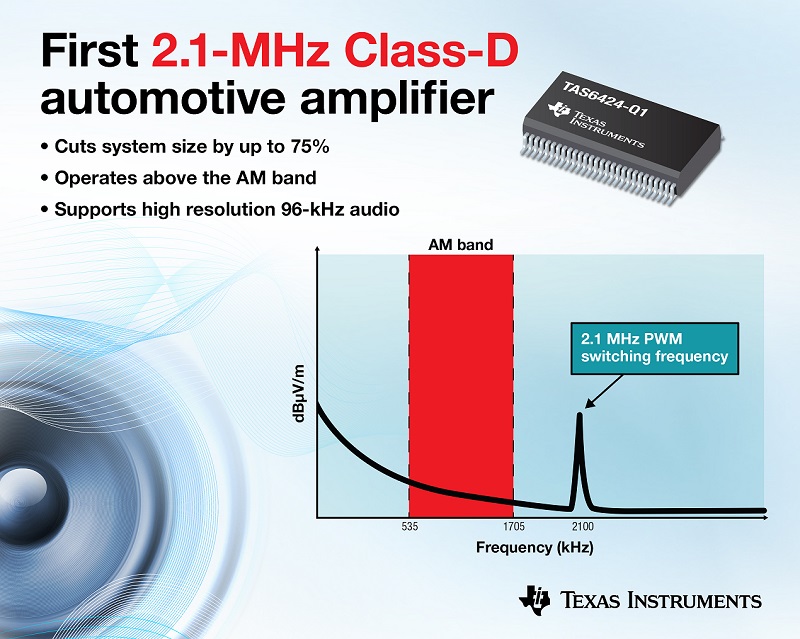 The TAS6424-Q1 four-channel, digital-input, Class D audio amplifier from Texas Instruments delivers up to 75 W of audio power with an efficient Class D architecture, yet it does not add to AM-band EMI burden due to its high 2.1-MHz switching frequency (Image: Texas Instruments)Recognizing this dilemma and tradeoffs, Texas Instruments has developed the TAS6424-Q1, a four-channel, digital-input, Class D audio amplifier designed for use in automotive head units and external amplifier modules. This 2.1 MHz Class D switching audio amplifier, rated at 75 W solves two problems: efficiency and noise.
As a Class D switching device, it is an efficient amplifier for bringing the audio to the desired power level, and this efficiency translates to both power saved in the auto subsystem as well as reduced thermal load. But Class D operation has a potential downside as well, and in fact can have unintended performance consequences that negate its efficiency benefits. The reason is that the energy-efficient switching operation of this architecture is itself a serious noise source, and one which most likely affects the AM radio itself. What TI has therefore done is increase the switching frequency of the TAS6424-Q1 to 2.1 MHz, well above the 535 kHz to 1705 kHz spread of the AM band in the United States (and similar worldwide).
TI claims this is the first Class D audio amplifier to operate at this high frequency; in contrast, existing units operate in the 400-500 kHz range that puts their fundamental near the lower edge of the band, and their harmonics right in it. Given that audio vendors (and their electronics suppliers) must now meet fairly stringent EMI specifications, this approach eliminates the need for complex noise-minimization and avoidance approaches and simplifies electromagnetic compatibility (EMC) designs, thus enabling the system to meet Comité International Spécial des Perturbations Radioélectriques (CISPR) 25 Class 5 EMC requirements which define noise impact.
The higher operating frequency of the TAS6424-Q1 benefits the BOM and PC-board footprint as well, as it requires smaller external filter components and also eliminates up to 18 external components, reducing system size and cost compared to existing Class D solutions.
Other beneficial attributes of this IC include ability to drive low-impedance loads, down to as low as 2 Ω; an advanced AC-load diagnostics and line-driver mode, providing detailed on-chip phase and impedance measurements that designers can use to configure the device with woofer, tweeter, and line-level output connections; low system-output noise of 42 μVrms; and greatly reduced dissipation of as much as 60% compared to linear Class AB simplifiers, which greatly reduces the thermal load and consequent need for advanced cooling, including fans or heat sinks (both of which is undeliverable, especially in a car).
Design support and pricing
A graphical user interface is available to help designers configure the TAS6424-Q1; designers can download an IBIS model and also use the evaluation module to simulate and optimize the device. There is also a brief video on the IC, a blog explaining AM-band noise and switching and, of course, a detailed 68-page data sheet. The TAS6424-Q1 is available now in a 56-pin PowerPAD™ thermally enhanced shrink small-outline package (HSSOP), priced at US$5.97 in 1,000-unit quantities.
