
This week, Popular Science, named The Power Over Wi-Fi system one of the most innovative and game-changing technologies of the year.
University of Washington (UW) engineers have developed the novel technology that uses a Wi-Fi router to power devices.
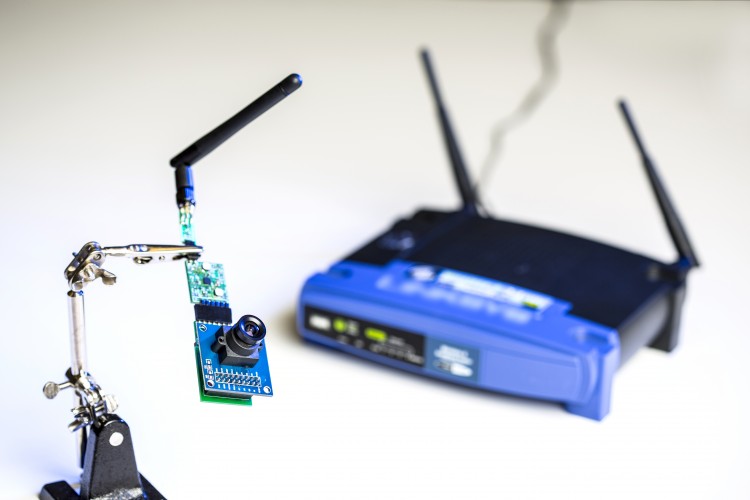 The UW team used ambient signals from this Wi-Fi router to power sensors in a low-resolution camera and other devices. Source: Dennis Wise/ UWThe UW engineering team used ambient signals from this Wi-Fi router to power sensors in a low-resolution camera and other devices.
The technology drew much attention earlier in the year when the team showed how they harvested energy from Wi-Fi signals to power a simple temperature sensor, a low-resolution grayscale camera and a charger for a Jawbone activity tracking bracelet.
Next month, the engineers present their final at the Association for Computing Machinery’s CoNEXT 2015 conference in Heidelberg, Germany, on emerging networking experiments and technologies.
The Technology’s Potential
“For the first time we’ve shown that you can use Wi-Fi devices to power the sensors in cameras and other devices,” says Vamsi Talla, a UW electrical engineering doctoral student. “We also made a system that can co-exist as a Wi-Fi router and a power source—it doesn’t degrade the quality of your Wi-Fi signals while it’s powering devices.”
PoWiFi has the potential to enable development of the Internet of Things (IoT), where small computing sensors are embedded in everyday objects such as cellphones, coffee makers, washing machines, air conditioners, mobile devices, allowing those devices to “talk” to each other.
One challenge in IoT products has been providing power to low-power sensors and actuators without needing to plug them into a power source as they become smaller and more plentiful.
The UW team discovered that the peak energy contained in untapped, ambient Wi-Fi signals often came close to meeting the operating requirements for some low-power devices. Since the signals are sent intermittently, energy was “leaking” out of the system during silent periods.
To fix that issue, they optimized a router to send out superfluous “power packets” on Wi-Fi channels that were not being used to enhance the Wi-Fi signal for power delivery, and they did this without affecting the quality and speed of data transmission. They also created sensors that could be integrated in devices to harvest the power. The team demonstrated how the PoWiFi system could wirelessly power a grayscale, low-power Omnivision VGA camera from 17 feet away, allowing it to store enough energy to capture an image every 35 minutes.
Then it re-charged the battery of a Jawbone Up24 wearable fitness tracker from zero to 41% in 2.5 hours. For further demonstration of how the system could be used to power IoT devices, the team tested the PoWiFi system in six homes.
The UW team believes there is opportunity to make the PoWiFi system efficient for use in everyday devices.
“In the future, PoWiFi could leverage technology power scaling to further improve the efficiency of the system to enable operation at larger distances and power numerous more sensors and applications,” says Shyam Gollakota, assistant professor of computer science and engineering.
To contact the author of this article, email engineering360editors@ihs.com
Related Links:
