
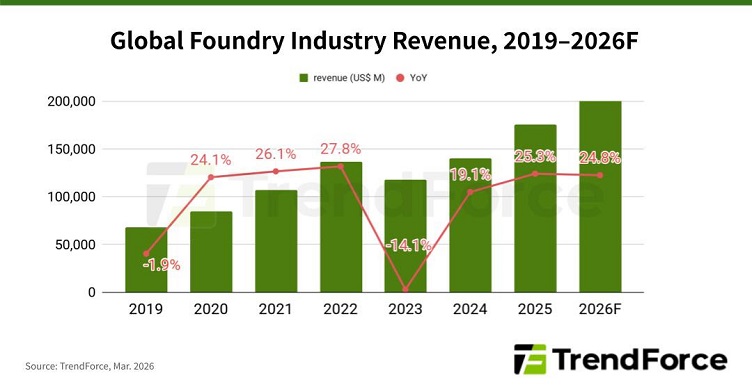
Global foundry revenue will be buoyed by the investment in AI processors and support ICs in 2026 with a projected 24.8% year-over-year increase to $218.8 billion, according to new data from market research firm TrendForce.
Leading foundry TSMC will post the largest increase of about 32% year-over-year growth, TrendForce said.
Demand from chipmakers Nvidia and AMD, data center vendors Google, Amazon and Meta, and AI startups like OpenAI and Groq is driving growth in foundries as these companies accelerate the development of their own AI chips.
TrendForce said many of these GPUs and CPUs are expected to enter volume production and begin shipping in 2026.
TSMC has seen its 5/4 nm capacity remain fully utilized through 2026 and Samsung Foundry reported an uptick in orders for its 5/4 nm-class nodes. TSMC has also increased foundry prices across all nodes at 5/4 nm and below for 2026. Further price increases cannot be ruled out, TrendForce said. Samsung also plans to raise its foundry pricing.
AI power management rising
At the 8-inch capacity, TrendForce said AI power management components are driving the foundry space and are helping to lift overall utilization rates. This is signaling a potential price increase at the 8-inch wafer level in 2026 as well.
Despite some improvement at the 8-inch fab space, these fabs are not expected to reach full utilization in 2026 and uncertainty in consumer electronics demand in the second half of the year may lead to downward shipment revisions in the supply chain, TrendForce said.
For 12-inch wafer fabs, capacity expansion of 28 nm and larger nodes will continue in 2026 despite uncertainty in high memory prices and a lack of demand for consumer electronics. TrendForce forecasts overall utilization rates for mature 12-inch nodes to remain below full capacity but strong momentum will continue for advanced nodes.
