
Take this hypothetical: You are running errands when your phone gets a notification. As you were driving past a Starbucks location, you get a suggestion to place a coffee order.
That couldn’t have been a coincidence, right? Nope.
It is an example of proximity marketing — an early, consumer-centric use of beacon technology. In this iteration, the beacon is a small, battery-powered wireless transmitter that uses Bluetooth Low Energy (BLE) to broadcast signals to nearby receivers, including many smartphones. Unlike traditional Bluetooth, beacons do not require pairing – they work with any BLE enabled device. Any latte lover just needs to enable that permission.
The combination of multiple consumer applications, such as promotional messages, navigation assistance centers and informational, has provided a proof-in-concept for beacon technology. Starting with the iPhone 4S launched in 2011, BLE was rapidly incorporated into virtually every cellphone and mobile operating system. And thanks to its ubiquity, a new use case for the technology started to emerge in the industrial sector.
GlobalSpec recently got the chance to learn more about the current state of this transition from Simon Ford, co-founder and CEO of Blecon, a U.K.-based technology company providing BLE-based infrastructure and network services for industrial and commercial connectivity.
“Bluetooth itself really got the kick-start out of consumer [applications] — especially Bluetooth Low Energy, which is what a lot of these beacons are based on. It was kind of a free ride to add the silicon into mobile phones,” Ford explained.
“Now that they’re there, you can unlock other things.”
A better BLE
At the top of Ford’s list of “other things” is asset tracking. The asset tracking model inverted the relationship between the two essential components of beacon communication. While the traditional retail approach relied upon fixed beacons to broadcast small data packets and mobile devices like smartphones to receive their signals, the asset tracking model does the opposite. The technology was placed directly on the mobile asset, allowing it to communicate with a fixed gateway infrastructure.
“I don’t think people would have bought these mobile computers to do asset tracking, asset sensing with Bluetooth devices — they couldn’t justify the costs,” Ford said.
But because mobile devices were already everywhere, companies can leverage their pre-existing infrastructure. As use cases for beacon technology expanded around the needs of industry, the limitations of the original, classic beacons started to become apparent.
They lack the capability for two-way communication, for instance, which means they cannot be remotely configured or updated, and the amount of data they can transmit is limited. They also operate on a basic broadcast model, without security features such as encryption or sender authenticity verification.
Smart beacons, by contrast, offer the capacity to establish full Bluetooth connections. This translates to the capacity to transmit larger volumes of data, acknowledge reliable delivery, and process input data from connected systems. The security vulnerabilities of classic beacons have also been addressed, and — unlike classic beacons — smart beacons can capture time-based insights and leverage AI and advanced analytics.
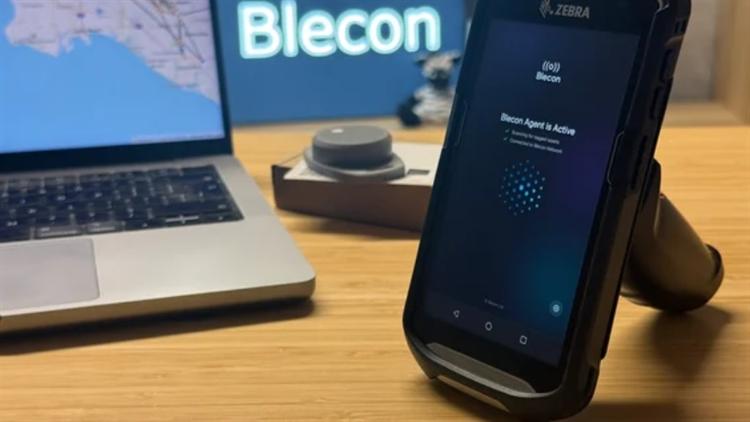
Yet smart beacons do share one very important aspect with their classic cousins: the potential for being deployed to existing infrastructure. That’s a key selling point of a new software solution announced by Ford’s company in February 2026, Blecon Agent, which is designed to be deployed across the global device system of leading front-line solutions provider Zebra Technologies.
Blecon Agent transforms the hardware already in the hands of a front-line workforce into an autonomous Bluetooth tracking network with continuous asset visibility. In this way, the workforce itself functions as the sensing layer, with visibility coming through the devices teams already carry, the spaces they already move through and the workflows that already exist. No new infrastructure or workers skillsets are required.
“All of that real estate that is covered by the people who are on the front line is now also a tracking and sensing network,” Ford explained. “Those workers don’t need to change their behavior; they don’t need to be trained.”
Ford believes that utilizing existing infrastructure also reduces financial and operational risks, making it easier for companies to adopt the technology. Plus, it allows for quick trials.
“Imagine if you had to go and install infrastructure to map across your supply chain,” he said. “That’s a lot of capital equipment — even if you just want to test it with one tag.”
By contrast, Blecon Agent can be rolled out to the whole fleet overnight. Altogether, that could translate to improving efficiency, spotting opportunities for sales and gaining a competitive advantage.
Ford added that Blecon’s unique approach is the key to maintaining its own competitive advantage.
“Bluetooth tracking and Bluetooth beacons have been around a long time, but there are lots of those companies [that] have grown up in that sort of fixed-infrastructure model,” he noted. “There’s always been this feeling that this technology is not being exploited as much as it could be.”
“I think perhaps what sets us apart is [that] we come with a sort of ‘mobile-first’ viewpoint, and obviously mobile devices have certain restrictions that, if you’re building your own gateway, you don’t have — you build architectures differently. We’ve come at it straight from a cloud-first approach, so the idea [is] that you’re not just tracking things around the warehouse — you’re thinking global.”
Looking ahead
As for what comes next, Ford predicted that the beacon technology landscape will shift in two dimensions. Basic asset tracking will be superseded by capabilities such as sensing, logging and verifying that offer more sophisticated asset visibility — not just where the asset is, but what it’s doing. Advances in printed batteries and electronics, and the transition into disposable form factors, will also lower the cost.
It's also worth noting that workforce-centric approach of Blecon Agent aligns well with the Industry 5.0 concept, which shifts the focus from leveraging smart machines for maximum efficiency to using technology to integrate and empower human capabilities.
“The fact that you can leverage, that that person is there, already doing something else, to collect data and really understand what’s going on in your business, is really interesting,” added Ford.
