
A remote-controlled mini robot capable of capturing oil spills using a sea-urchin-inspired filtering system has been developed by a team of RMIT University engineers in Australia.
The minibot, dubbed the "Electronic Dolphin," is, as its name suggests, shaped like a dolphin and roughly the size of a sneaker. Designed to collect oil from the surface of water, the Electronic Dolphin features a specially designed filter that simultaneously repels water while instantly absorbing oil, thus enabling the device to effectively skim slicks and collect oil.
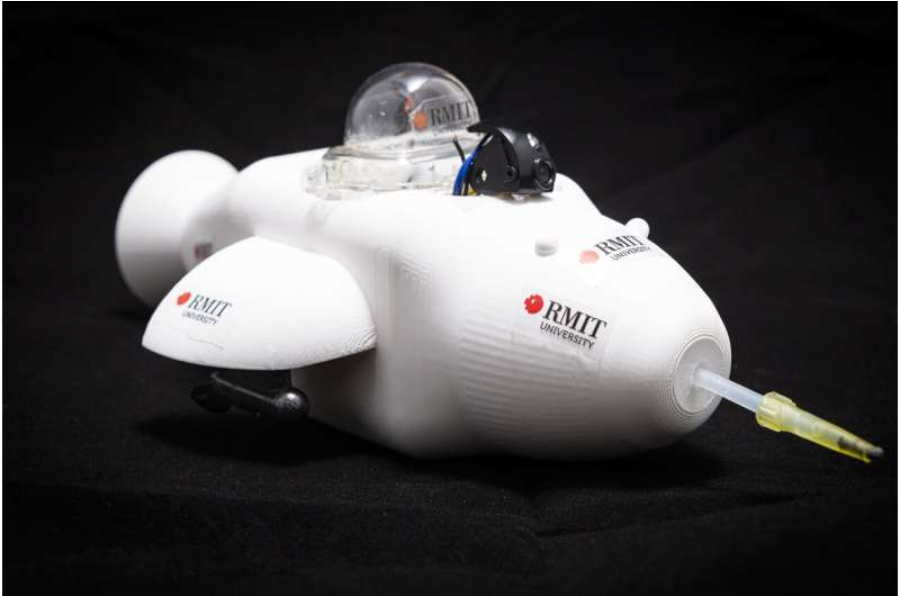 Source: Peter Clarke, RMIT University
The team suggests that the proof-of-concept minibot was built to demonstrate how small platforms could potentially support clean-up efforts without exposing responders to hazardous conditions.
"Oil spills can take a huge environmental and economic toll. We wanted to create a system that can be deployed quickly, steered accurately and used in areas that are too risky for people to access," the researchers explained. "We have a long-term vision of creating dolphin‑sized robots that can vacuum oil, return to base to empty their tanks, recharge, then redeploy automatically — repeating the cycle until the job's done."
Instead of past oil cleanup materials that typically use harsh and hazardous chemicals, the Electronic Dolphin uses an eco-friendly coating for the filter, which is located at the front of the robot along with a small pump that draws oil through the filter into an onboard collection chamber.
During trials, the minibot recovered oil at approximately 2 milliliters per minute with more than 95% purity, thus maintaining performance without the filter becoming waterlogged.
According to its developers, the filter’s coating grows tiny, sea urchin-like spikes that are only visible under an electron microscope. These sea urchin-like spikes feature pockets of air that force water to roll off, while oil adheres to the surface. As such, the material can vacuum up oil without soaking up water.
Going forward, the researchers are investigating how to increase the filter area across the robot's surface, which would require a higher capacity pump
An article detailing the Electronic Dolphin, “Multifunctional Superwetting Sea‐Urchin‐Mimetic Nanosheet‐Based Interface for Remote Oil‐Water Separation,” appears in the journal Small.
