
The world’s largest foundry and chipmaker, TSMC, has entered into a $197 million land purchase intended for a future gigafab in Arizona that could include at least five additional fabs in Arizona.
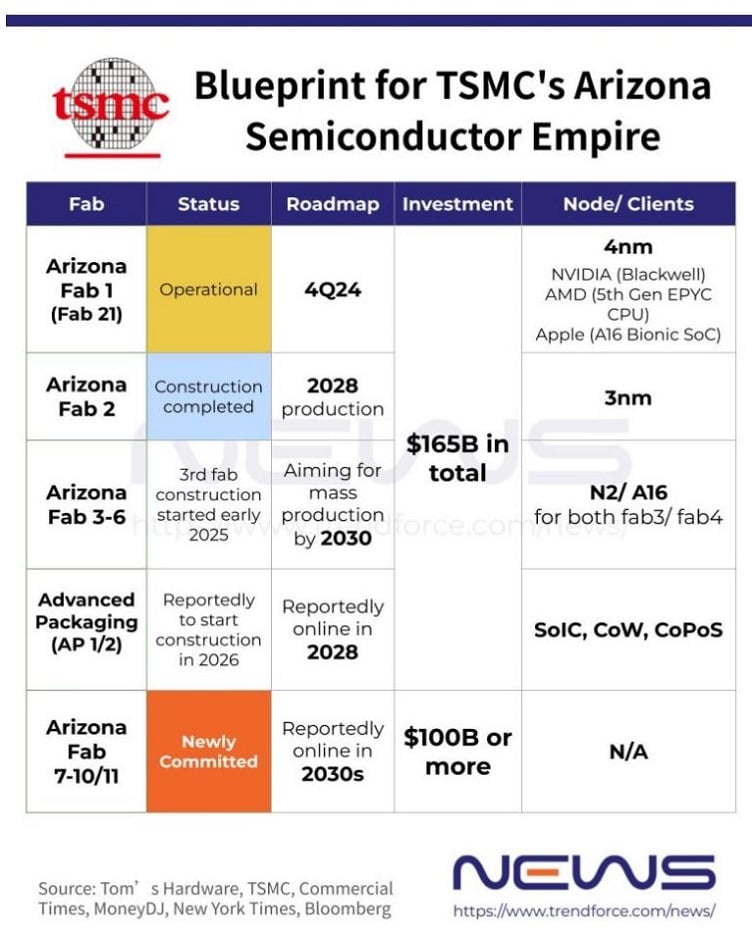
Currently, TSMC is in the process of building three semiconductor manufacturing fabs in the state with another three fabs planned. Arizona Fab 1 is operational as of the fourth quarter of 2024. Arizona Fab 2 has completed construction and is on track for production by 2028. Fabs 3-6 are aimed for production by 2030. TSMC is also in the process of constructing two advanced packaging facilities reportedly to begin operation by 2028.
The Arizona Fabs 7-10/11 will be constructed and operated in the 2030s.
According to the New York Times, TSMC is in the final stages of clinching a trade agreement with the U.S. that would cut tariffs on Taiwanese exports to 15% and TSMC is central to the deal.
The move comes as the Trump Administration is imposing a 25% tariff on certain advanced computing chips citing semiconductors like the Nvidia H200 and AMD MI325X. The tariff will not apply to chips that are imported to support the buildout of the U.S. technology supply chain and strengthen the domestic manufacturing capacity of semiconductors, the Trump Administration said.
Another report from Bloomberg said that TSMC will commit to at least four additional chipmaking plants in Arizona, adding to the six factories and two advanced packaging facilities already under construction in the state.
Because a single fab costs more than $20 billion, TSMC’s expanded investment could surpass $100 billion if four or five new plans come online in the 2030s, Bloomberg reported.
The outlet notes that with construction costs for a single fab exceeding $20 billion, TSMC’s expanded investment could approach or surpass $100 billion. The four new plants are expected to come online in the 2030s, according to a source familiar with the matter cited by Bloomberg. This would expand the $165 billion investment pledge that TSMC has committed to in 2025.
The fabs would be used to build logic chips, high performance computing chips and AI semiconductors.
