
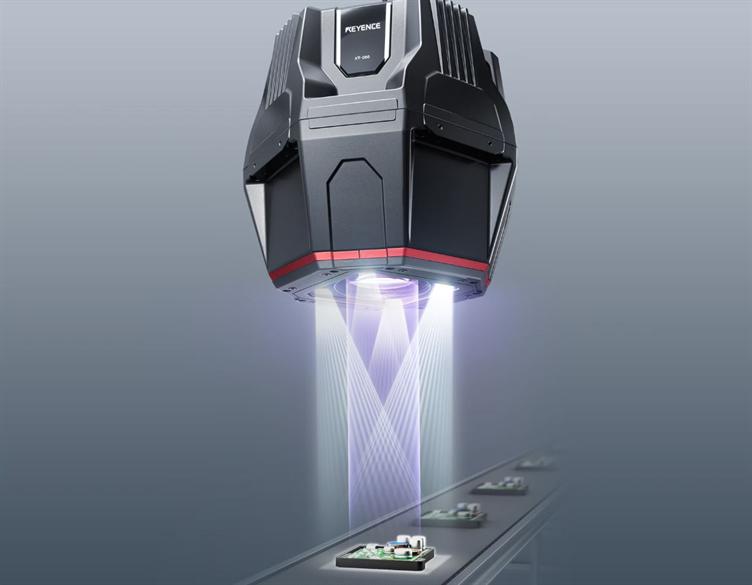
As companies transition to smart factories, greater investment is happening in automation systems that provide spatial data as well as real-time feedback.
3D machine vision is one of the key areas of investment in automation as robots increasingly rely on 3D vision to interact with parts, especially for pick-and-place, bin-picking and precision assembly. Robotics-guided vision system with 3D depth sensing is a core growth engine for smart factories and automation.
As more industries demand greater intelligence and precision in automation along with the convergence of robotics, AI and smart manufacturing, 3D machine vision is growing in importance. Add to this the advancement of sensor technologies and the need to retrofit legacy automation lines, the adoption of 3D machine vision systems is accelerating quickly.
According to Grand View Research, the 3D machine vision market is expected to reach $15.6 billion by 2030, managing a compound annual growth rate (CAGR) of 14.3% in the next five years.
What is 3D machine vision?
3D machine vision differs from its 2D counterpart as an advanced form of industrial vision technology that allows devices to perceive depth, shape and spatial relationships of objects. Unlike 2D visions systems, 3D machine vision reconstructs three-dimensional information about an object’s surface (e.g., size, orientation, depth and topology).
The technology uses visual inputs from multiple angles to perceive objects and environments to detect and measure metrics that 2D systems might miss.
This comes in handy in industrial applications where more specific data is needed to detail complex or irregularly shaped parts such as:
- Inspection and quality control
- Gauging and measurement
- Robotic guidance
- Object recognition and location
- Logistics and warehouse automation
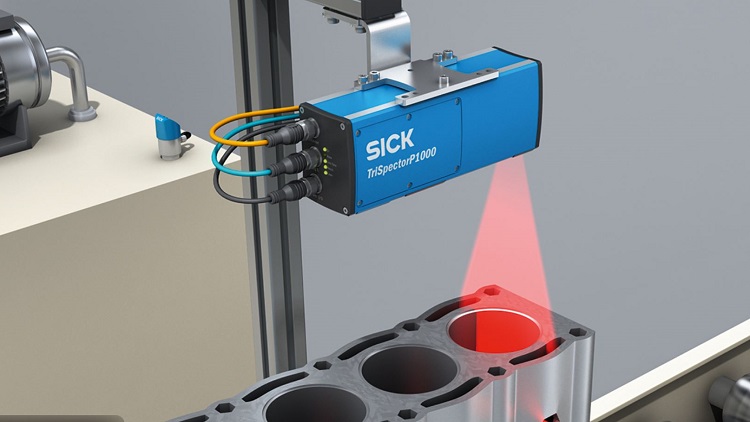 Some 3D vision systems are used to discover defects on assembly lines or on factory floors of a smart factory. Source: Sick Connect
How it works
3D machine vision uses a variety of techniques to capture this depth, shape and spatial information. This includes:
- Laser triangulation
- Stereo vision
- Structured light
- Time-of-flight (ToF)
Laser triangulation, or profilometry, projects a line onto a scene where an image is recorded by an image sensor. Calculations are then based on triangulation, and the 3D models are built line-by-line.
Laser triangulation relies on movement of an object along with the sensor moving as well. This is often used in inspection moving on a conveyor belt. This technology can also be affixed to a robot end effector to scan objects, or the use of a robotic arm provides the necessary motion.
Structured light is a technique where the camera captures how the pattern deforms when hitting an object’s surface after a pattern is projected onto an object. From these distortions the system can reconstruct a detailed 3D point cloud.
Stereo vision, also known as binocular vision, uses two or more cameras to capture the same scenes from different viewpoints. This allows the system to triangulate their 3D positions based on disparity. Stereo vision produces a depth map allowing calculation of position from each matched point.
Finally, ToF is a sensor technology that emits light pulses toward an object. This measures how long the light takes to reflect to the sensor. This is used to calculate distance for each pixel.
Using all these technologies combined, 3D machine vision can extend traditional machine vision by capturing depth not just flat images.
Challenges
The adoption of 3D machine vision systems is not without some issues that industrial automation vendors will need to deal with.
First is the complexity of the systems. These 3D vision systems generate large amounts of data, which requires compute and skilled resources to handle. Second, the cost of these machines is not cheap.
For small- and mid-sized companies, the initial hardware and software costs will be a barrier that may prevent them from investing. At least, until the costs fall when the machines scale up.
Another challenge for companies will be finding a skilled workforce with the special knowledge of optics, calibration and data processing for deployment and operation of 3D machine vision systems.
Conclusion
3D machine vision systems are used to create three-dimensional images that are created profile by profile by moving the object through a region and moving the camera over the object. Much like a regular camera that snaps a picture, 3D vision systems create a 3D image that is more accurate and can be used to analyze volume, shape or 3D position of objects. It can also be used to detect parts and defects or used for measuring, inspection and positioning.
The market is on the rise due to automation vendors wanting more intelligence and precision in their smart factories. This is being buoyed by the convergence of robotics, AI and smart manufacturing.
As sensor, software and hardware technologies improve and mature, it is likely 3D machine vision will continue to be adopted by high-end vendors and, as the price falls due to scalability, medium and smaller companies as well.
