
Do you remember the days when getting on the internet involved dialing a number — using a landline, no doubt — followed by approximately 30 seconds of waiting for the high-pitched squawks and beeps of modem handshakes to give way to a clear signal?
Then along came broadband, which relied upon coaxial cable or optical fiber to establish connections to the internet that were far more seamless. Broadband allowed for the rise of local area networks (LANs) and wide area networks (WANs), which could incorporate both wired and wireless connectivity, planting the seeds of an idea that one should be able to send email, play games, stream audio and watch video channels just about anywhere. Over a short span of time, as supporting technologies like cellular service and Wi-Fi became increasingly ubiquitous, that revolutionary concept largely turned into reality.
Thinking back now to the days of dial-up, those squawks and beeps seem almost quaint relics, not unlike the clip-clop of hooves from a horse-drawn carriage.
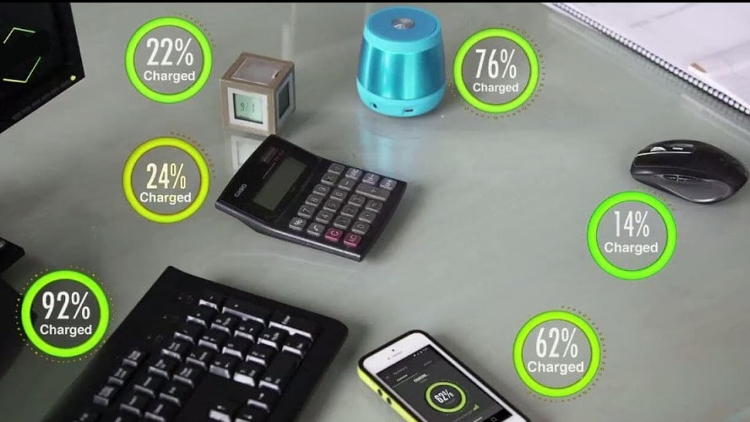
Today, a similar revolution is underway in the realm of power. Though, it might at first seem like the stuff of science fiction, wireless power networks (WPNs) are fulfilling the dream of a seamless, always-on experience that may soon place the common everyday power outlet into the same category as yesterday’s modems.
“We’re going to go from cable power, to basically power everywhere,” said Giampaolo Marino, senior vice president of strategy and business development at Energous Corporation, a company working on the cutting edge of the WPN field.
GlobalSpec got a chance to catch up with Marino recently, to learn more about the current state of the technology.
What is WPN?
The WPN concept is an expansion of the principle of near-field power transfer, which occurs within magnetic fields (using inductive coupling between wire coils) or electric fields (using capacitive coupling between metal electrodes). Nikola Tesla was an early pioneer in the exploration of wireless transmission, designing radio frequency (RF) resonant transformer circuits that now bear his name as “Tesla coils.” Though the inventor failed to make a commercial product from his findings, his methods continue to be applied in short-range systems — medical implant devices like pacemakers and smartphone charging pads using the Qi inductive standard, for instance — and it would seem that his dream of transmitting power wirelessly over long distances into homes and factories may be an idea whose time has finally come.
Marino, in fact, sees the current state of the technology as mature, and he anticipates accelerated market adoption within the next two to five years. This timeline reflects not only technological advances, but also the clearing of regulatory hurdles thanks to safety demonstrations, which have shown that the human impact of the electromagnetic interference (EMI) produced by WPNs is negligible — significantly less, in fact, than the potential impacts from long-term cellphone use.
Scaling up from consumer tech
For its part, Energous has been developing technology in the wireless power space for 12 years and holds over 250 patents with a primary emphasis on RF-based wireless power transfer. Three years ago, the company pivoted from consumer-based applications, like charging cellphones and laptops, to focus on the IoT space — finding ways to power sensors and IoT nodes wirelessly and eliminate the need for batteries, cables and human intervention for maintenance.
The shift, according to Marino, has revealed applications in a range of fields such as transportation, logistics, retail and manufacturing, with the common thread of eliminating costs associated with current sensor topologies and enabling new sensors to collect more data. This empowers much more intelligent decisions in supply-chain operations than is currently possible with radio frequency identification (RFID) tags, which require scanning and provide only a fraction of the insight.
“Think of [RFID] like you’re in a super-dark room, and then you have a torch light,” Marino said.
“And now you’re turning on your torch light, you’re shining light onto a corner of that room. You can see what’s going on in that corner, but you don’t see what’s going on around you. It’s all dark still.”
By contrast, Energous takes an “always-on” approach to data collection not subject to the node and sensor constraints of cables and batteries. This provides full visibility that effectively “turns the lights on,” eliminating supply chain “dark spots” where assets can be lost or spoilage can occur.
This dynamic is the basis for what Marino refers to as “ambient IoT,” which is also a focus of Wiliot, a supply chain intelligence company and Energous partner. Wiliot’s IoT Pixels are sensor tags that operate on Bluetooth Low Energy (BLE) without batteries, powering themselves by harvesting energy from radio waves. Leveraging the Wiliot tag has enabled Energous to expand its supply-chain capabilities.
“Assets are basically automatically digitized, and data flows seamlessly from the asset to the cloud or customer network,” Marino explained.
The Wiliot-Energous combination has also enabled Marino’s company to demonstrate scalability into a wide range of customer infrastructures, paving the way to large-scale deployments such as the retrofitting of one-million-square-meter facilities at a fraction of the cost of RFID.
“We are basically deploying this technology today. This is not like a science project like it used to be, maybe three or four years ago,” Marino added.
And still, this is only the beginning.
“This technology, it’s going to expand, and it’s not just going to focus on IoT,” Marino said. “It’s going to focus on many other applications that are part of our everyday lives. It could be a smart home, it could be a smart building, it could be a smart city” — each of which provides an example for the growing need to deploy sensors to collect data that will feed AI.
By delivering regulated power through the air, WPNs will transform energy into a background utility that enables those sensors (and a trillion other devices) to operate autonomously — without batteries, cables or the maintenance costs that have historically been required.
And what about those power outlets? Will they disappear?
“Eventually, yes,” Marino said. “And cables are going to disappear, and everything is going to be done wirelessly. That’s the way the future is going.”

