
Quantum computers are poised to solve problems that are beyond even the most powerful classical computer. While the latter function under deterministic rules, quantum computers operate on quantum bits, or qubits, that allow them to perform many calculations at the same time. The technology exploits superposed and entangled states and the non-deterministic outcomes of quantum measurements as features of its computation.
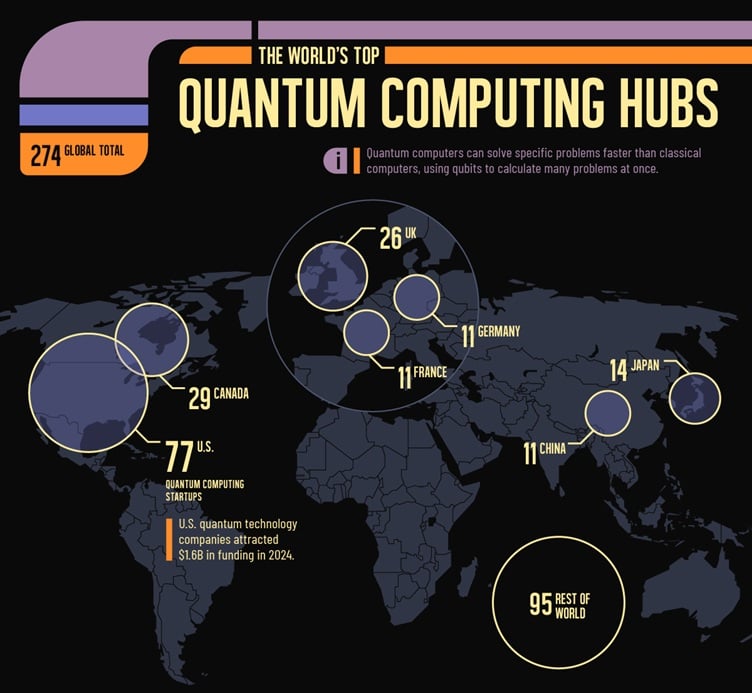
A survey conducted by McKinsey reveals that the U.S. stands as the leading hub for quantum computing startups, with 77 overall. Startups as well as big tech firms are investing in this technology. Nvidia, for instance, recently announced it was building a quantum computing research center in Boston, Massachusetts, to integrate with its supercomputers in efforts to bring quantum computing applications into reality.
Canada ranks second globally, at 29 startups, with key players including Xanadu Quantum Technologies and Photonic Inc.
The potential arrival of Q-Day, when quantum computers become powerful enough to break current encryption standards and critical digital infrastructure worldwide, represents a major shift in security. Companies will need to rethink their global security strategies, as quantum communication technologies allow the secure transfer of quantum information at scale, and the market is growing quickly.
