
As the Greek philosopher Heraclitus observed many centuries ago, “the only constant in life is change.” This certainly can be seen in the perpetual flux of the electronics world, where there is scarcely time to reflect upon the impact of any single innovation before efforts get shifted toward the realization of the next one. When one considers the fact that meaningful innovations are only made possible with thorough testing, it’s easy to see how the rapid pace of electronics evolution presents challenges for testing methods to keep up.
This dynamic is well understood by test and measurement instrumentation company Chroma, as evidenced by a pair of recent announcements that touch upon disparate arenas of the electronics landscape.
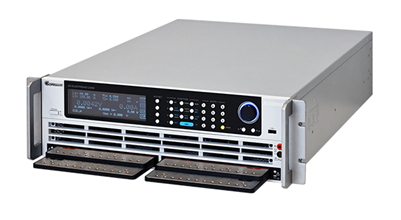 The Ultra Low Voltage DC Electronic Load 63202A-20-2000 is just one example of a tool designed to keep testing methods on pace with rapid innovation in the electronics world. Source: Chroma ATE Inc.First, high-end audio. Products like wireless headphones, wireless speakers and multichannel gaming headsets represent just a small sampling of the kinds of devices driving innovation and growth in today’s highly competitive consumer electronics market. Even in mid- to low-end market segments, manufacturers are packing their products with advanced features in an effort to stand out and stay competitive: high-bitrate codecs, low power consumption, smart charging, smart noise cancellation, multi-microphone calling, health tracking — and the list goes on.
With so much cutting-edge technology packed into every device, traditional system-on-chip (SoC) testers face technical bottlenecks and prohibitive costs for gauging advanced audio quality metrics like signal-to-noise ratio, harmonic distortion and dynamic range. Specifically engineered to improve audio test quality and efficiency, Chroma’s MXADO Mixed-Signal Module Board is designed to enhance the company’s existing 3380 Series of SoC testers, like the VLSI Test System 3380. According to Chroma, the new board enables accurate measurement of an array of audio performance indicators, allowing manufacturers to conduct a wider range of product tests with cost-effectiveness and precision — and, in the process, retain their competitive edge.
Then there’s the rapidly developing field of generative AI, with its increasingly impressive capabilities ranging from voice and image generation to medical imaging. Because these technologies require massive amounts of complex and real-time computation, the servers delivering them must be equipped with high-performance central processing units (CPUs) and graphics processing units (GPUs). For power, these processors require VCORE regulators, embedded DC-DC converters or voltage regulator modules (VRM). Their voltage output range is approximately 0.6 V to 1.5 V, with VCORE current ranging between 300 A and 800 A. Current ranges for GPU power supply are typically 800 A to 1400 A, continuing to trend toward higher currents and power. To validate these low-voltage power supplies, as Chroma explains, engineers typically employ electronic loads to simulate their load characteristics and test high-current output specifications. Conventional electronic loads, however, frequently struggle to handle issues such as insufficient voltage for proper current draw, or difficulty connecting to the unit under test (UUT) due to inadequate terminal contacts.
Its solution? The Ultra Low Voltage DC Electronic Load 63202A-20-2000, which is specifically designed to facilitate highly accurate and convenient CPU and GPU power supply testing. It operates within a voltage range of 0 to 20 V with a rated power of 2 kW. To accommodate the especially low output voltages of CPU and GPU power supplies, the 63202A-20-2000 features a unique design enabling it to draw current up to 2,000 A at voltages as low as 0.25 V. Even when the voltage drops down into the 0.2 V to 0 V range, Chroma said, the load retains its ability to draw current — an essential capability for realistic simulation and accurate testing of GPU power supplies. The unit also features a unique front copper busbar terminal design that facilitates easier connection to the UUT, with interconnected left and right busbars and added insulating plates between the positive and negative busbars to prevent short circuits. This design enables low-inductance connections, significantly enhancing the load's dynamic response speed and allowing a current slew rate of 60 A/us at 0.5 V. Chroma also offers optional ultra-low self-inductance load cables that effectively minimize voltage drops or current overshoot during dynamic current testing.
