
Security systems, home automation equipment and IoT devices typically rely on passive infrared (PIR) sensing for presence and motion detection. Sensor responses are triggered by moving objects observed through a Fresnel lens — an invention that dates to the 19th century lighthouse.
ST Microelectronics has taken a new approach. Its new sensor, the STHS34PF80, contains thermal transistors that can detect both moving and stationary objects, while also enabling a simpler, lens-free construction. With its embedded smart algorithm for presence and motion detection, the new sensor is fit for a wide range of smart devices. It also consumes less power than a conventional PIR, and it offers both high resistance to unwanted direct lighting effects and high immunity to electromagnetic interference.
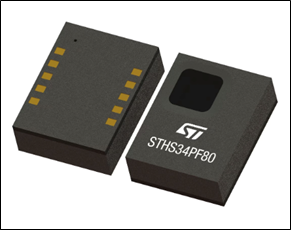 The STHS34PF80 sensor uses thermal transistors to detect both moving and stationary objects, enabling lens-free construction. Source: ST MicroelectronicsThe sensor relies upon thermal metal-oxide-semiconductor field-effect transistors (MOSFETs) (TMOS) sensitive to the heating effects of infrared radiation incident on their gates, as well as digital readout circuitry integrated onto the same chip using silicon-on-insulator (SOI) CMOS technology. The SOI’s architecture facilitates micromachining with the company’s micro electromechanical systems (MEMS) processes to thermally isolate the TMOS for accurate temperature sensing.
The TMOS is powered at a sub-threshold voltage below what’s needed to turn the transistor fully on. In this mode, the drain-source current is highly temperature dependent, producing an accurately measurable response to minimal infrared radiation. This enables the sensor to detect a human presence via infrared emissions, whether the person is moving or still. That same sub-threshold operation also translates to very low power consumption, which means that battery-powered sensors containing the sensor can operate for long periods between charging or battery replacement.
In addition, the standard CMOS fabrication technology ensures cost-effective sensor production with high wafer yield, also leveraging sub-micron transistor geometry for small sensor dimensions. This contrasts with PIR sensors, for which sensitivity can depend on pyroelectric-pixel size. The integrated digital interface also allows direct connection to the host without analog front end circuitry.
The STHS34PF80 offers a lens-free range of 4 meters and an 80° field of view, and an operating current of 10 µA. Its compact surface-mount package (3.2 mm x 4.2 mm x 1.455 mm) is suited to automated high-speed assembly. An available evaluation kit simplifies experimenting with the new sensor, for which drivers are available on GitHub.
