
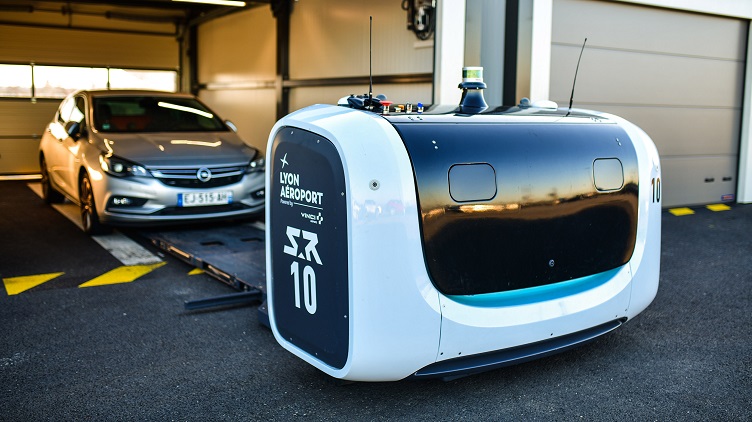
Lidar is coming to automated robot valet systems after Velodyne Lidar Inc. signed a multi-year agreement Stanley Robotics.
The automated valet parking uses autonomous handling robots to help car parks improve parking experiences as well as increase the number of vehicles that can be stored in a lot.
With Velodyne’s Puck and Velarray M1600 lidar sensors onto the all-electric robots will provide real-time 3D perception data for localization, mapping, object classification and object tracking. The sensors are designed to help the robots in challenging environmental conditions including varied temperature, lighting and precipitation.
The Stanley Robotics automated valet parking solution with the lidar sensors is already in operation in airports and finished vehicle logistics in Europe and Japan. The companies said further deployments are expected in 2023 including in North America.
A few years ago, Stanley Robotics launched a pilot project at Lyon Airport in France to use the robots in 2,000 parking spaces. The company has partnered with Vinci Airports to expand the outdoor robotic parking service into a new phase after a successful trial involving 500 spaces.
The outdoor car park is managed by seven autonomous robots working simultaneously that were developed by Stanley Robotics and Vinci Airports. The partnership aims to ultimately offer more than 6,000 parking spaces at Lyon Airport.
“High-performance sensors are key to enabling our autonomous mobile robots to reliably navigate and maneuver in narrow parking lanes,” said Mathieu Lips, COO of Stanley Robotics. “Velodyne’s lidar sensors deliver the performance for Stanley Robotics’ innovative solutions. This agreement reflects Velodyne's ability to serve the unique nature and high-level requirements of our use cases. This partnership with Velodyne also provides Stanley Robotics privileged access to best-in-class technology in the field of lidar sensors.”
