
To power self-driving cars, a high-performance process will be needed to make the computations necessary for the car to navigate and identify issues on the road.
Nvidia has introduced the next-generation of artificial intelligence (AI)-enabled processors for autonomous vehicles called Nvidia Drive Atlan. According to Nvidia, Atlan is capable of delivering more than 1,000 trillion operations per second (TOPS) for vehicle models beginning in 2025.
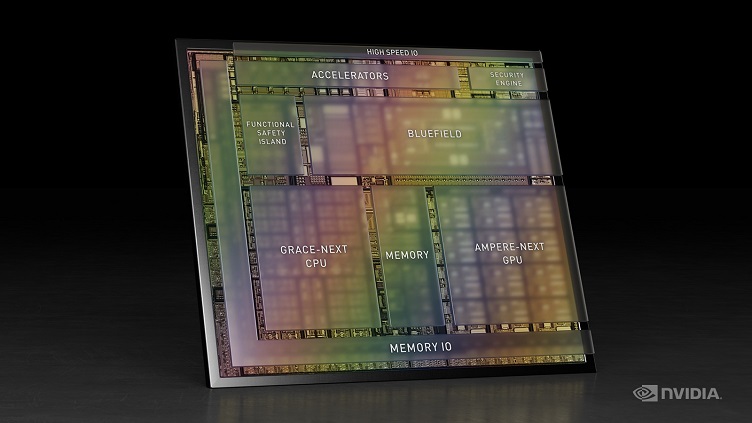
The system-on-chip (SoC) integrates AI and software with the latest in computing, networking and security, Nvidia said. Atlan will include new graphics processing unit (GPU) architecture, new Arm central processing unit (CPU) cores, as well as deep learning and computer vision accelerators. This gives the automotive GPU data-center-like performance for automakers to build software-defined vehicles that are programmable and upgradeable through secure, over-the-air updates.
“The transportation industry needs a computing platform that it can rely on for decades. The software investment is too immense to repeat for each car,” said Jensen Huang, founder and CEO of Nvidia. “NVIDIA DRIVE is the most advanced AI and AV computing platform, with rich global software and developer ecosystems, and architecturally compatible for generations.”
Atlan integrates Nvidia’s BlueField data processing unit (DPU) for a broad range of advanced networking, storage and security services to support complex compute and AI workloads found in autonomous vehicles. BlueField offers data-center-infrastructure-on-a-chip programmability, along with security to prevent data breaches and cyberattacks.
Nvidia’s previous self-driving car GPU, Drive Xavier, delivers 30 TOPS and can be found in production cars and trucks today and the Drive Orin with 254 TOPS will be included in new vehicles starting in 2022.
