
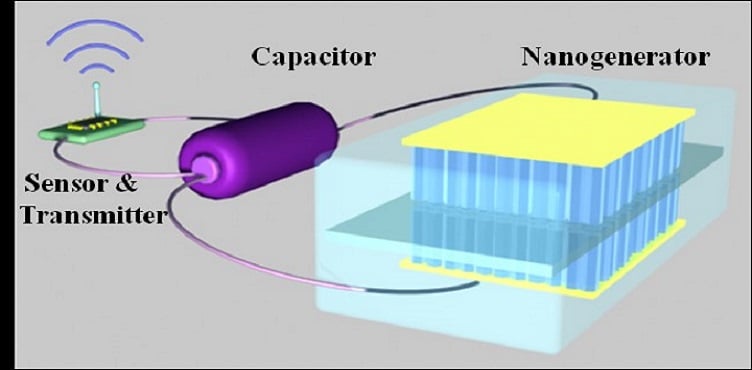
Wireless and portable nano- and micro-scale technologies are being increasingly used in medical implants, environmental controls, industrial protection, defense equipment and personal electronics, including chemical sensors and nanowire-based gas and programmable nanowire circuits for nanodevices. Until recently, most micro and nanodevices were dependent on old-style energy sources, such as the power from a lithium ion battery. Despite advances in the long-term efficiency and battery dimension reductions, comparatively big battery size, inevitable recharging or replacing requirements continue to pose a challenge when producing and operating such batteries.
Moving toward nanoscale
Recent advancements in piezoelectric nanomaterial fabrication methods have resulted in smaller piezoelectric generators capable of replacing much larger generators. Piezoelectric materials harvest the mechanical energy available in rich amounts in the environment, for example, energy in airflow, mechanical vibration, raindrops and hydraulic pressure, and convert it into electrical energy via a process known as the “piezoelectric effect.” The piezoelectric nanogenerators were first introduced by Wang and Song in 2006, who were able to produce an impulsive output voltage of magnitude of several millivolts from zinc oxide nanowires with the tip of an atomic force microscope. The recent interest in this nanogenerator has increased due to the possibility of using them for micro- and nano-scale power supply systems.
Until now, there has been a lot of development in the structure of piezoelectric nanogenerators and many kinds are available including flexible nanogenerators. These are providing a range of mechanical energy harvesting possibilities. The electrical voltage has been expanded from few millivolts to many hundred volts and can be used to drive LCDs, LEDs and wireless data communicating devices. The main structures of piezoelectric nanogenerators include the lateral-aligned nanowire networks, vertically aligned nanowire arrays and nanowire-based nanocomposites.
Lateral-aligned nanowire networks
In lateral-aligned nanowire piezoelectric nanogenerators, the nanowires are laterally bent for deformation either via bending the substrate or via applying pressure in a radical direction to the nanowires; the nanowires are equally bent during these processes. By ignoring the strain produced radically, the equal bending action in lateral direction of the 1-D nanostructure can be called the lateral stretching and is attributed to their extremely high aspect ratio. Research has also shown that lateral manufactured piezoelectric nanorods can produce more piezoelectric voltage than vertically manufactured nanorods given the same outside pressure. This makes them useful in the design of piezoelectric nanogenerators.
Vertically aligned nanowire arrays
In vertically aligned nanowire arrays, two separate working models are used for nanogenerators, for instance vertical compression and lateral bending. Given the different mechanical and electrical configurations, the operating process is dissimilar in various ways but similar in one: the piezoelectric characteristic of piezoelectric nanowire and semiconductor behavior coupling. If a nanowire is bent when tempted by an atomic force microscopy (AFM) tip, a Schottky barrier develops among them because of different electron affinity and working functions. The AFM tip is responsible for producing the piezoelectric potential because of compression and stretching of the outer and inner sides of the nanowire. Overall, the electrons flow in the wire in a circular path, and output current would be detected in the measuring instruments.
Nanowire-based nanocomposites
Composites based on nanowire-polymer materials are used to engineer a relatively new kind of piezoelectric nanogenerator. These devices have a simple manufacturing process and structure involving four working layers: the front and back electrodes, the crucial nanowire-composite layer and the flexible substrate. This multilayer construction is also similar to piezoelectric ceramics. While the piezoelectric properties of these nanowire composites can be inferior to those of ceramics, the matrix of polymer greatly enhances the flexibility of piezoelectric nanogenerators. Lead zirconate titanate nanowires are also used for fabricating these nanocomposites and deliver an achievable output voltage of 7 V when bent manually. This type of nanogenerator has demonstrated outstanding power performance along with low cost and easy fabrication techniques that can be used for large-scale manufacturing.
Applications of piezoelectric nanogenerators
Nanoscale piezoelectric generators will extract biomechanical energy from the twisting of a humanoid finger, the release and folding of a humanoid elbow and even the racing movement of a real chipmunk. Progress has been made in creating piezoelectric nanogenerators with the ability to transform the mechanical energy from the pulse and breath of a mouse into power output. Apart from human and animal-derived mechanical energy, certain other types of mechanical energy present in the ecosystem may also be extracted by these piezoelectric nanogenerators. These include harnessing the mechanical pressures from a driving car and raindrop impacts, and the vibrational influence of air flows and liquid.
Conclusion
In the past few years, the advancements in the structure and design of piezoelectric nanogenerators have greatly enhanced their voltage production from a few millivolts to several volts. These nanogenerators are now being deployed in different fields depending upon how they can harvest the mechanical energies in the environment. These systems are being used as power sources for powering microelectronic devices, self-powered sensors, active sensors and hybrid power supply modules.
