
The loss of muscle control experienced by amyotrophic lateral sclerosis (ALS) patients robs them of the ability to speak. A wearable sensor that can detect small deformations of the skin may provide this cohort with a way to communicate through facial movements. The device designed by researchers from MIT, University at Buffalo, Institute of Microelectronics and Agency for Science, Technology and Research (Singapore) could prove less expensive and more effective than available assistive communication technologies.
An MIT engineer on the research team was inspired to develop the skin-worn sensor after meeting physicist and ALS patient Stephen Hawking, who relied on an infrared sensor to detect movements of his cheek and direct a cursor across a computer screen. This time-consuming process requires bulky equipment, and similar systems 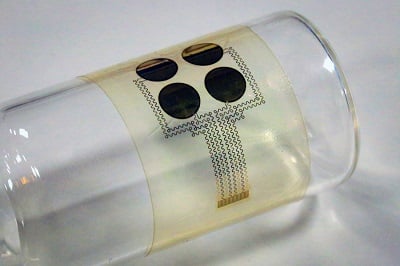 The device could help ALS patients communicate nonverbally. Source: David Sadat/MITthat measure facial nerve activity suffer from poor accuracy. The new flexible, wearable interface eliminates the need for complex peripherals and supports nonverbal communication.
The integrated system for decoding facial strains and for predicting facial kinematics includes conformable thin films encasing aluminum nitride piezoelectric sensors that detect deformation of the underlying skin and convert this to an electrical signal that is measured by a handheld processing unit. Proper placement of the sensor device and interpretation of facial movements are achieved with machine learning algorithms and digital imaging correlations.
In tests with two ALS patients, the technology was shown to be about 75% accurate at distinguishing between three facial expressions: smiling, pursed lips and open mouth. Both the accuracy and the number of identifiable expressions should increase as the system is fine-tuned and a library of phrases is collected. The device could be inexpensively produced for about $10 as all components can be mass-produced.
