
A new carbon nanotube-based battery electrode designed by NAWA Technologies of France promises to improve power by a factor of 10 and reduce charging time down to minutes instead of hours. Based on patented vertically aligned carbon nanotube (VACNT) technology, the ultra fast electrode can also boost energy storage by a factor of three and lifecycle by a factor of five.
Activated carbon electrodes are commonly manufactured with a mix of powders, additives and binders that undermine electrical, thermal and ionic conductivity and lead to premature delamination and safety issues. 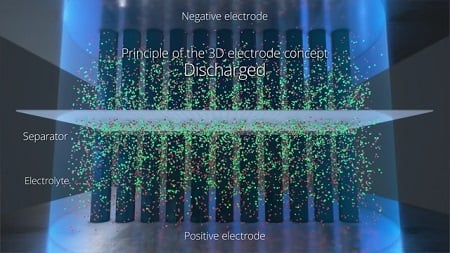 The nanotube electrodes pictured in a discharged state. Source: NAWA TechnologiesThe advent of VACNT technology enhances ionic conductivity in a 3D fully accessible nanostructure with high electrical and thermal conductivity, provided by the arrangement of 100 billion nanotubes/cm2, all vertically aligned. Production in a one-step roll-to-roll process at atmospheric pressure enables mass manufacturing of large area electrodes at a lower cost than current batteries.
The recyclable electrode is a universal system and can be used with existing and advanced new battery chemistries. The device is available as both a primer for existing electrodes where the VACNTs increase electrical conduction, and as a full 3D-electrode where the nanotubes serve as a framework on which lithium insertion material can be coated. NAWA is developing different concepts of coatings with various chemistries and expects the technology to be introduced and in production as early as 2023.
Installed in an electric vehicle, an advanced lithium-ion battery with the ultra fast electrodes could double the kWh stored and help realize 1,000 km driving ranges.
