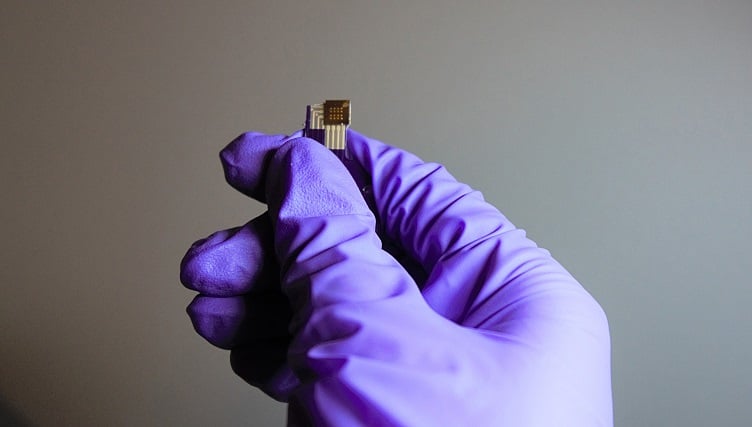
Artificial intelligence (AI) has become prevalent in electronics, but it requires vast amounts of energy in some cases. As such, researchers at Purdue University are developing hardware that can learn skills using a type of AI that currently runs on software platforms — an approach that could offset the energy needed for using AI in advanced applications such as self-driving cars or future drug discovery.
“Software is taking on most of the challenges in AI. If you could incorporate intelligence into the circuit components in addition to what is happening in software, you could do things that simply cannot be done today,” said Shriram Ramanathan, a professor of materials engineering at Purdue University.
While AI hardware is in the early stages of development, researchers have demonstrated potential hardware but have not addressed the large energy demand for AI.
The Purdue team demonstrated an artificial “tree-like” memory in a piece of potential hardware at room temperature. Researchers previously have only been able to observe this kind of memory in hardware at temperatures too low for electronic devices.
Software uses tree-like memory to organize information into various “branches” so the information can be retrieved easier. The strategy is inspired by how the human brain categorizes information and makes decisions.
“Humans memorize things in a tree structure of categories. We memorize ‘apple’ under the category of ‘fruit’ and ‘elephant’ under the category of ‘animal,’ for example,” said Hai-Tian Zhang, a Lillian Gilbreth postdoctoral fellow in Purdue’s College of Engineering. “Mimicking these features in hardware is potentially interesting for brain-inspired computing.”
How they did it
The team introduced a proton to a quantum material called neodymium nickel oxide. They discovered that applying an electric pulse to the material moves the proton. Each new position of the proton creates a different resistance state, which then creates an information storage site called a memory state. Multiple electric pulses create a branch made up of memory states. Thousands of memory states in the material can be built to take advantage of quantum mechanical effects. The material stays the same and it is just a matter of shuffling around protons.
Through simulations, researchers showed the material can learn the numbers 0 through 9, which is the baseline test for AI. Creating hardware at room temperature in a material is a step toward showing that hardware could offload tasks from software. Purdue said this opens up new frontiers for AI that have previously been unavailable because electronic hardware did not exist.
The breakthrough could also pave the way for naturally communicating with AI in the future, which is essential for next-generation healthcare such as a brain implant.
The full research can be found in the journal Nature Communications.
