
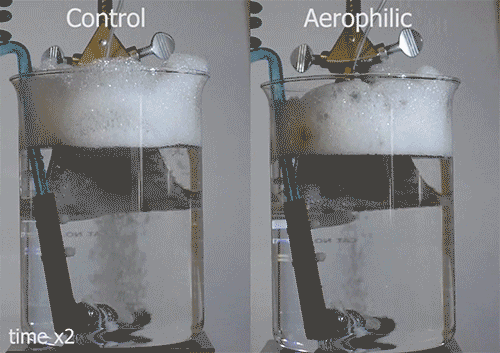
 Source: Varanasi LabResearchers from Massachusetts Institute of Technology (MIT) have developed a new system for preventing foam buildup in valves and other industrial processing equipment components using sheets of textured mesh material.
The mesh sheets are textured, or aerophilic, surfaces that attract, capture and dissipate bubbles. The sheets are comprised of three layers, the outermost layer, which is called plastron, behaves like the feathers that keep diving birds dry when they dive underwater. The plastron traps the foam bubbles before they can bounce away and then dissipates them.
To demonstrate how the sheets work, the researchers placed two beakers in the lab side by side, one with the textured sheets and one with untextured sheets. When foam was added to the beakers, the beaker containing the textured sheets rapidly dissipated the foam whereas the beaker with the untextured sheets did not. Instead, the bubbles bounced away, leaving room for more to form.
Industrial processes, such as bioreactors that create fuels and pharmaceuticals, have long been plagued by foam buildup, which tends to disrupt such processes. The foam takes up space, thereby reducing the volume left for producing the actual product. The foam can also gum up valves, which also disrupts production.
To remedy this, chemical additives like glycol or alcohol are often combined with the ingredients being processed. However, the added chemicals can damage product purity and add an extra processing step for removing the de-foaming additives.
As such, the researchers believe that the textured sheets could be easily incorporated into industrial processing applications such as beer brewing, shampoo and cosmetics processing, paper making, oil and gas production and processing, biofuel generation and chemical processing.
The research appears in the journal Advanced Materials Interfaces.
