
Researchers from Michigan Technological University, Purdue University, Washington University and the University of Texas at Dallas created a nanowire that could bring wearable technology one step closer to reality. For wearables to be a viable option, the wiring needs to be strong, flexible and efficient — characteristics achieved by the new nanowire.
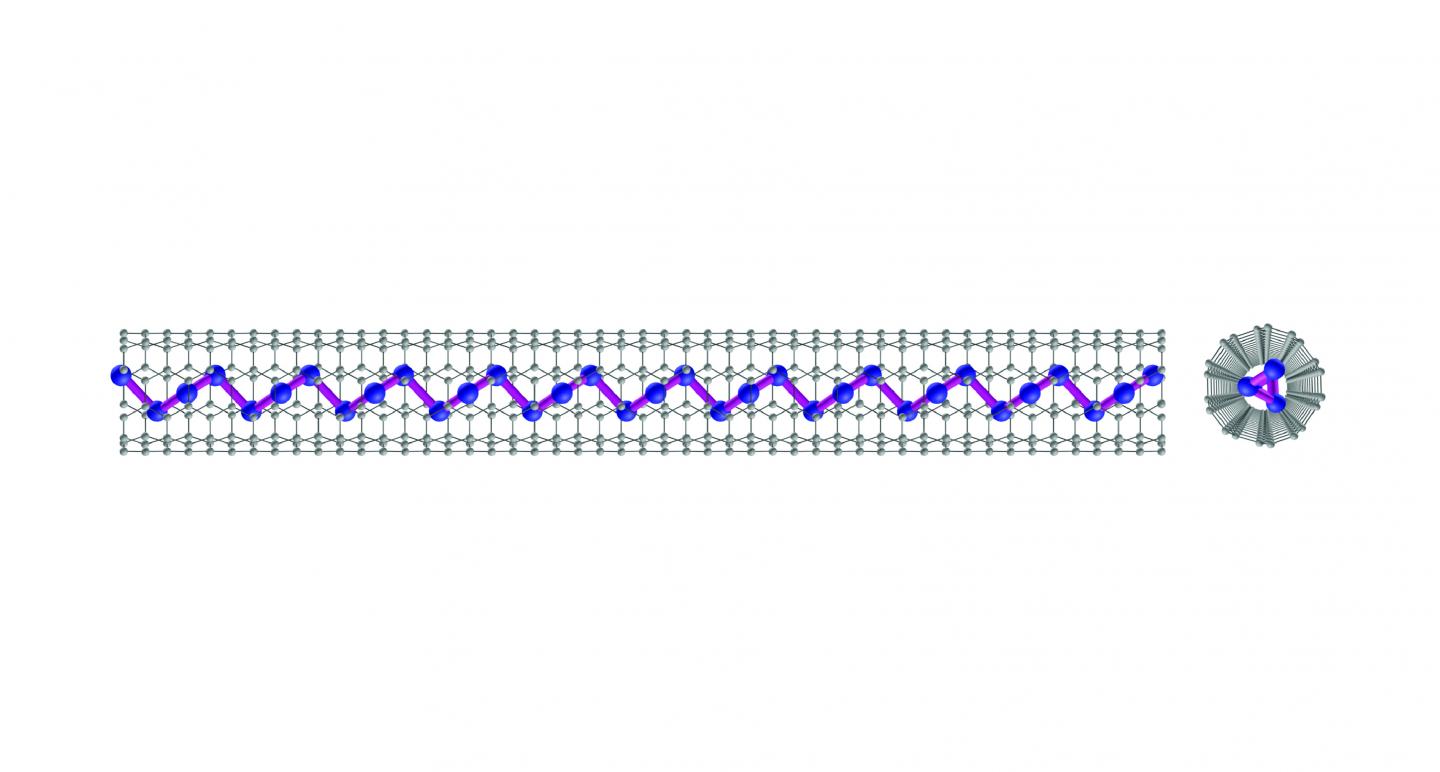 Researchers have discovered that a material forms a DNA-like helix when reduced to a string of atoms, as seen by the pink line in this graphic, encapsulated in a nanotube. Source: Purdue University/Pai-Ying Liao
The demand for smaller and faster devices is constantly growing. With this demand comes with a demand for materials with properties that can deliver superior performance without shrinking or tearing. To achieve this, researchers started by tuning the atomic structures of nanomaterials. The perfect nanomaterial for wearables needs to bend with the body, not snap or stretch out, hold up under a variety of temperatures and hold enough energy to run for a long period of time.
The new nanowire is made of tellurium atomic chains encased in boron nitride nanotubes (BNNT) controlled by light and pressure. BNNTs are hollow in the middle, highly insulating, strong and flexible. Tellurium is a metalloid similar to selenium and sulfur. It has unpredictable behavior, hence the need to isolate it with BNNTs. Tellurium atomic chains create a tiny wire with a lot of current-carrying capacity. BNNTs that encapsulates the tellurium chains allowed the researchers to isolate signals from atomic chains and review their quantum behavior. Tellurium-BNNT nanowires created a field-effect transistor that is two nanometers wide with a current-carrying capacity of 1.5 x 108 cm2.
Before the nanowire can be used, the nature of atomic chains need to be characterized, which is the next step for the team.
A paper on the nanowires was published in Nature Electronics.
