
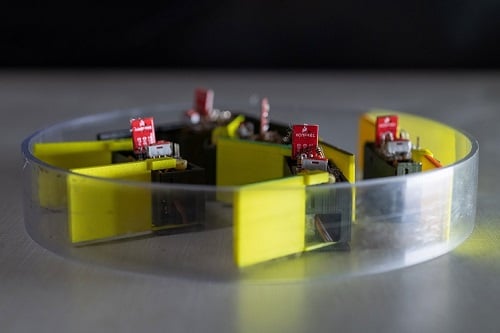
 Smarticles are 3D printed and when combined move to respond to stimulus. Source: Army Research LabScientists at the U.S. Army Research Lab (ARL) have developed robots built entirely from smaller robots to potentially unlock new methods of locomotion for military vehicles.
The smaller robots, known as smarticles (short for smart active particles), are 3D printed and can do just one thing: flap their two arms. When five of these smarticles are confined in a circle, they nudge one another, forming a robophysical system known as a "supersmarticle" that can move by itself. Adding light or sound sensors enables the system to move in response to stimulus and be controlled well enough to navigate a maze.
The research could lead to robotic systems capable of changing their shapes, modalities and functions. The behavior of the group could provide a new locomotion and control approach for small robots that could potentially change shape. Someday a robotic swarm could be capable of moving to a river and then autonomously forming a structure to span the gap.
"These are very rudimentary robots whose behavior is dominated by mechanics and the laws of physics," said Dan Goldman, a professor in the School of Physics at the Georgia Institute of Technology and the project's principal investigator. "We are not looking to put sophisticated control, sensing and computation on them all. As robots become smaller and smaller, we'll have to use mechanics and physics principles to control them because they won't have the level of computation and sensing we would need for conventional control."
How they did it
ARL researchers used a 3D printer to create battery-powered smarticles that have motors, simple sensors and limited computing power. The robots can change their location only when they interact with other devices while enclosed by a ring.
When the smarticles are put in the ring to form a larger robot, the tiny robots flap their arms to move around the larger robot randomly. During testing, researchers found that when one of the small robots stopped working — for example if the battery died — the rest of the small robots started moving in the direction of the non-working robot.
Using this as a method for potential locomotion, researchers added photo sensors to the small robots that stopped the arm flapping when a strong beam of light hits the robot, simulating a robot failure. This way, researchers could move the larger robot in the direction they wanted it to go.
The next steps involve more complex interactions using simple sensing and movement capabilities of the smarticles. This could eventually lead to robotic systems being used to enhance situational awareness and mission-command capabilities for small Army units in difficult-to-maneuver environments such as cities, forests, caves or other tough terrain.
