
Watching the battery percentage on a mobile phone drop is a common source of anxiety, so any effort to make charging fast and easy is generally well received. One convenient solution is growing in popularity yet is not without a downside, according to a recent study by the Warwick Manufacturing Group (WMG) at the University of Warwick.
The researchers examined induction chargers and found that due to increased heat generation, they have the potential to shorten battery life in phones with standard lithium-ion (li-ion) batteries.
Inductive charging eliminates the need to plug in a cable by allowing a power source to transfer energy across an air gap. The researchers studied the heat generation in both the charger and the phone and compared it to the heat that results from charging a phone via a cable. They identified several factors that can lead to excessive heat. Functional constraints dictate that the phone’s battery and power electronics be positioned close together. The heat generated by these components cannot easily dissipate and the phone is not protected from the heat generated by the charger. In addition, the heat from one device can be transferred to the other by thermal conduction and convection.
(Learn more about Battery Chargers on GlobalSpec.)
The study also looked at what happens when the phone and charger are misaligned and found that, to compensate for the misalignment, inductive charging systems often increase the transmitter power or adjust the operating frequency that contributes to loss of efficiency and further increases heat generation.
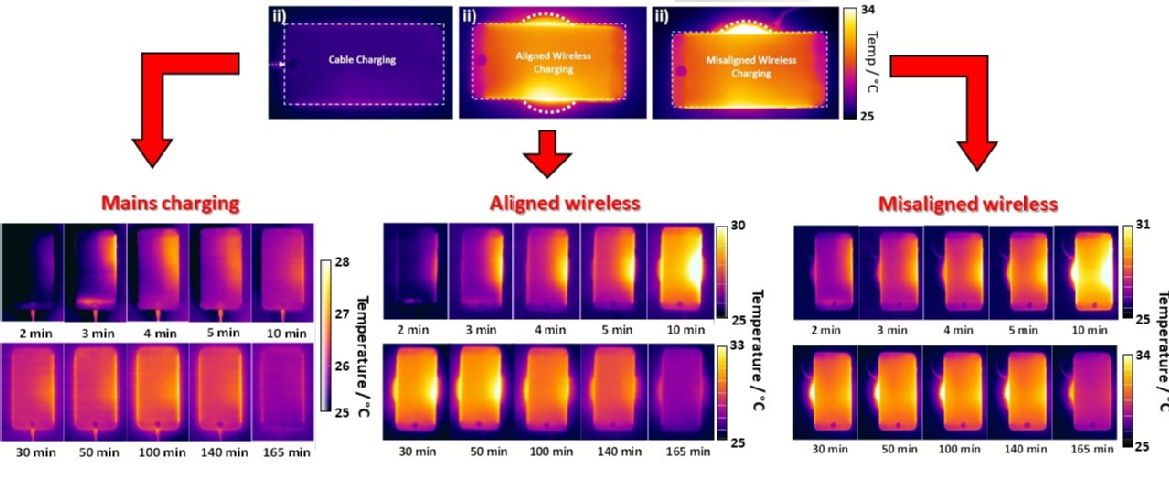 Three modes of charging, based on (a) AC mains charging (cable charging) and inductive charging when coils are (b) aligned and (c) misaligned. Source: WMG, University of Warwick
Batteries stored at or exposed to high temperatures age more quickly. For a li-ion battery, storage above 30° C is considered to be high enough to shorten its useful life and manufacturers advise that the operating temperature should not exceed 50° C to 60° C, WMG reported.
The team used simultaneous charging and thermal imaging over time to test wired, aligned inductive and misaligned inductive charging. The resulting temperature maps allowed them to quantify the heating effects of the various methods. The experiments showed that the greatest potential for battery degradation came from inductive charging, particularly when the phone and charger were misaligned.
An article in Digital Trends agrees that temperature impacts battery life but states that wireless charging is not necessarily the culprit. To prevent exposing a phone to excessive heat, the article recommends not leaving the phone in direct sunlight or in a hot car, not playing graphically intensive games while the phone is charging, and only using certified wireless charging pads or wired chargers.
The results of the WMG study are published in ACS Energy Letters.
