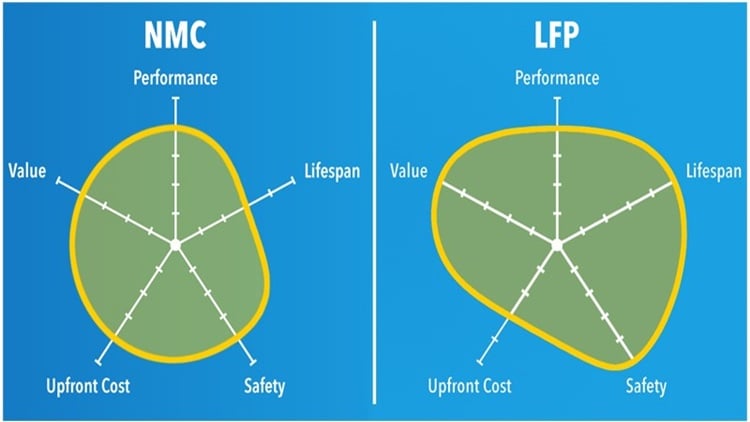
What is the distinction between nickel manganese cobalt (NMC) and lithium iron phosphate (LFP) batteries?
NMC batteries
NMC batteries are lithium-ion batteries with a cathode made of lithium, nickel (Ni), manganese (Mn) and cobalt (Co) oxides. Common variants like NMC 532 or 811 (indicating Ni-heavy ratios) offer high energy density (150 Wh/kg to 250 Wh/kg), making them ideal for electric vehicles (EVs) requiring long ranges, such as premium models like the Tesla Model S or BMW i4. However, NMC batteries are costly due to scarce and volatile-priced materials like Co (~$30/kg to $40/kg in 2025) and nickel, and they pose safety risks due to potential thermal runaway at high temperatures (~200° C).
LFP batteries
LFP batteries use a LFP cathode, relying on abundant and inexpensive iron and phosphate. They have lower energy density (90 Wh/kg to 160 Wh/kg), suited for shorter-range EVs or stationary storage, but excel in safety (stable up to ~400° C), longevity (2,000 to 5,000 cycles versus NMC’s 1,000 to 2,000), and cost (~20% to 30% cheaper per kWh). Their simpler chemistry also reduces environmental and ethical concerns tied to Co mining.
Why the shift from NMC to LFP?
The transition to LFP is driven by:
- Cost reduction: LFP’s use of cheap, abundant materials lowers battery costs (~$80/kWh to $100/kWh versus NMC’s $100/kWh to $130/kWh), critical for affordable EVs like the Tesla Model 3 Standard Range or BYD Atto 3.
- Safety: LFP thermal stability reduces fire risks, aligning with stricter EV and grid storage regulations.
- Supply chain security: Avoiding Co and Ni mitigates reliance on volatile markets and ethically problematic mining (e.g., Congo’s Co mines).
- Sustainability: LFP’s eco-friendly materials and easier recycling align with global ESG goals, like the EU’s 2027 recycling mandates.
- Market fit: LFP suits budget EVs and energy storage (e.g., Tesla Megapack), where range is less critical than durability and cost. In 2024, LFP’s EV battery market share hit ~40% globally (60% in China), up from 10% in 2020, per BloombergNEF.
- Cycle life: LFP batteries significantly outperform NMC, offering 2,000 to 5,000 cycles at 80% DoD, with some advanced designs (e.g., BYD Blade) claiming up to 6,000 cycles.
Chemistry comparison
NMC chemistry
- Cathode composition: NMC batteries use a layered oxide cathode, LiNi_xMn_yCo_zO_2, where x+y+z=1. Common ratios include NMC 532 (50% Ni, 30% Mn, 20% Co), NMC 622 and NMC 811 (80% Ni, 10% Mn, 10% Co). Higher Ni content boosts energy density but reduces stability.
- Mechanism: Ni provides high capacity, manganese enhances structural stability and Co improves conductivity and cycle life. Lithium ions shuttle between the cathode and a graphite anode during charge/discharge.
- Challenges:
- Thermal runaway: High Ni content increases reactivity, risking fires at ~200° C if damaged or overcharged.
- Degradation: Ni-rich cathodes suffer from cation mixing (Ni²⁺ migrating to lithium sites), reducing capacity over time.
- Co dependency: Co is scarce, expensive (~$30/kg to $40/kg in 2025), and ethically problematic due to mining practices.
LFP chemistry
- Cathode composition: LFP uses LiFePO4, an olivine-structured cathode with Fe and phosphate. No Ni or Co is involved.
- Mechanism: Iron phosphate forms a stable 3D framework, allowing lithium ions to intercalate with minimal structural change. This stability reduces degradation and heat generation.
- Advantages:
- Thermal stability: LFP withstands temperatures up to ~400° C before decomposing, minimizing fire risk.
- Longevity: The rigid olivine structure resists cracking, enabling 2,000 to 5,000 cycles versus NMC’s 1,000 to 2,000 cycles.
- Low cost: Fe and phosphate are abundant and cheap (iron ~$0.1/kg), reducing material costs by ~30% compared to NMC.
- Challenges:
- Lower voltage: LFP operates at ~3.2 V per cell versus NMC’s ~3.7 V, reducing energy density (90 Wh/kg to 160 Wh/kg versus 150 Wh/kg to 250 Wh/kg).
- Conductivity: LFP has lower electronic conductivity, requiring carbon coatings or nano-structuring, which adds processing costs.
Challenges and trade-offs
- NMC’s edge: NMC’s higher energy density (150 Wh/kg to 250 Wh/kg versus LFP’s 90 Wh/kg to 160 Wh/kg) suits long-range EVs, where lifespan is secondary to performance. Replacing an NMC battery after 8 to 10 years may be acceptable for premium models (e.g., BMW i4).
- LFP limitations: While LFP excels in cycle life, its lower energy density requires larger, heavier battery packs for equivalent range, which can impact vehicle design and efficiency.
- Emerging improvements: Innovations like doped LFP (e.g., Mn-doped LMFP) could push cycle life even higher while improving energy density, further favoring LFP adoption.
NMC battery applications
- Premium EVs:
- Use case: High-performance and long-range EVs, such as the Tesla Model S, BMW i4, Mercedes EQS and Rivian R1T.
- Challenges: Higher costs and thermal runaway risks require advanced battery management systems (BMS) and cooling, increasing vehicle complexity.
- Electric SUVs and crossovers:
- Use Case: Mid-to-high-end SUVs like the Ford Mustang Mach-E (Extended Range), Hyundai Ioniq 5 and Kia EV6.
- High-performance applications:
- Use case: Electric supercars and motorsport applications, such as Rimac’s Nevera or Formula E racing.
- Challenges: Limited cycle life and safety concerns require specialized cooling and limited production runs.
- Limited energy storage applications:
- Use case: Small-scale, high-density energy storage systems, such as portable power stations or backup systems for critical infrastructure (e.g., data centers).
LFP battery applications
- Entry-level and mid-range EVs:
- Use case: Affordable EVs with ranges of ~200 to 300 miles, such as the Tesla Model 3 Standard Range, BYD Atto 3 and Ford Mustang Mach-E (Standard Range).
- Electric buses and commercial fleets:
- Use case: City buses, delivery vans and taxi fleets (e.g., BYD e6, Rivian EDV for Amazon).
- Stationary energy storage:
- Use case: Grid-scale storage (e.g., Tesla Megapack, CATL EnerOne), residential storage (e.g., Tesla Powerwall) and renewable energy integration (solar/wind).
- Two- and three-wheelers:
- Use case: Electric scooters, motorcycles and rickshaws, especially in Asia (e.g., Super Soco, Ola Electric).
- Emerging applications:
- Marine and aviation: LFP is gaining traction in electric boats and small electric aircraft (e.g., Pipistrel Velis Electro) due to safety and weight tolerance in short-range missions.
- Off-grid systems: LFP powers remote microgrids and telecom towers, leveraging its long lifespan and low maintenance.
Conclusion
NMC offers higher energy density (150 Wh/kg to 250 Wh/kg) but is costlier and less safe, while LFP provides lower costs (~$80/kWh to $100/kWh), superior safety, and longer lifespan (2,000 to 5,000 cycles versus NMC’s 1,000 to 2,000 cycles). Market trends show LFP’s rise (~40% EV market share, 70% in stationary storage by 2024) due to cost, safety and sustainability advantages, especially in China. LFP dominates entry-level EVs (e.g., Tesla Model 3, BYD Han), commercial fleets and grid storage, while NMC remains preferred for premium, long-range EVs. Innovations like cell-to-pack designs are enhancing LFP’s competitiveness. The shift is driven by LFP’s alignment with cost-sensitive, high-cycle and safety-critical applications.
