Reshoring is a phenomenon that is growing in the U.S. for two main reasons: Geopolitical matters and supply chain resilience and security.
Bringing jobs back to the U.S. is important for a variety of issues. As the world continues to deal with potential disruptions in the supply chain due to pandemics (like COVID-19), wars, natural disasters and more, having a supply chain closer to home reduces risk to national security and the economy, and reduces dependency on foreign goods.
To discuss this topic, Electronics360 chatted with Harry Moser, founder and president of the Reshoring Initiative, regarding his participation at this year’s FabTech and the reasons why the U.S. is increasing its reshoring.
Electronics360: Reshoring has become a huge topic in the last 10 years with numerous government policies being put in place to encourage companies to bring manufacturing back to U.S. soil. Why has this become such a hot button issue?
Harry Moser: The U.S. has lost about 5 million jobs to offshoring. Around 1980, our goods trade was balanced, and we had a $1.2 trillion deficit in 2024. It will take about 5 million employees to produce enough to get back to balance. The benefits of regaining balance include:
- Mfg: +40%.
- Income equality: Improved. Much stronger middle class.
- Budget deficits: Down.
- Emissions: Lower. 75% of manufacturing emissions are in the supply chain. Sourcing locally instead of in Asia reduces emissions 25% on many items.
- GDP: +5%.
- Innovation: Improved. Innovation is more effective if manufacturing is close by.
- Automation/competitiveness: Strengthened. Surging investment will increase productivity.
- Defense industry capability: Sufficient. Currently we would run out of defense materials in a few weeks of a serious war.
- Manufacturers: More of them and more secure jobs. Modern facilities.
- Annual capital investment: +50% “forever” to build the capacity to produce 40% more and then stay productive.
E360: How have measures like the CHIPS and Science Act and the Inflation Reduction Act contributed to reshoring?
Moser: Reshoring surged to new records in 2021 and 2022 (343,000 jobs) under President Biden, driven by the $100 billion in funding from those acts. Grants drove about 40% of reshoring and foreign direct investment (FDI) jobs. However, the budget deficit is too high to continue.
E360: The Trump Administration has continued this reshoring push with new agreements from TSMC, Apple, Micron and others. Do you expect to see more of these agreements happening in the semiconductor manufacturing space?
 Harry Moser is the founder and president of the Reshoring Initiative.Moser: On a much smaller scale. The capacity from the existing projects will far exceed domestic demand for chips. China assembles a huge percentage of our electronic products and prefers their own chips. Trump prefers tariffs and, maybe, lower USD to such subsidies.
The correct policy would be to motivate more U.S. assembly of electronic products to increase the market for U.S. chips.
E360: What role do supply chain interruptions or geopolitical issues play in companies looking to reshore?
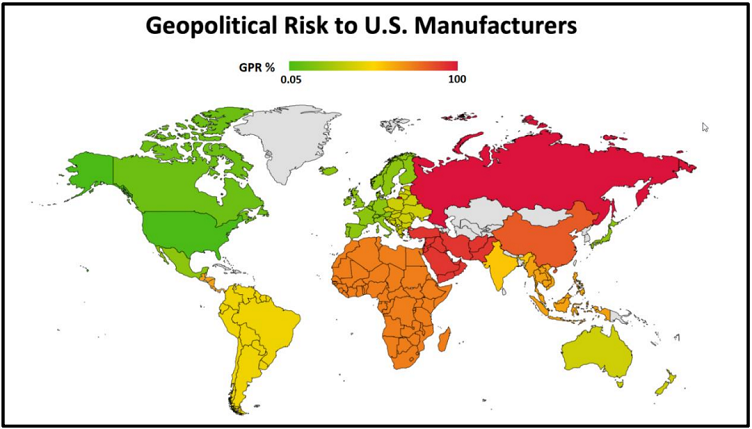
Moser: Geopolitical risk, especially regarding China/Taiwan, is one of the top 2 motivators. See our Reshoring Survey. Our Geopolitical Risk map is a useful tool for companies considering reshoring as geopolitical risk insurance.
E360: Do you see reshoring as a permanent trend or a temporary adjustment?
Moser: A permanent, inevitable but long-term trend. Inevitable since continued loss of manufacturing will leave us so weak militarily and economically as to question our survival. Also, continued massive trade and budget deficits will result in a collapse of the USD, which will automatically enable reshoring and FDI.
E360: What skills are most in demand for the reshored operations, and is the local workforce prepared?
Moser: The workforce is not sufficient in quantity or preparation. Compared to competitor countries we have very weak basic education, poor recruiting to skills jobs and haphazard training. The good news is that other countries are experiencing similar problems, and our students and counselors are increasingly choosing skills training versus liberal arts university degrees.
Skills are in demand across industry. I hear the most about welding, AI and robotics.
E360: What are some of the biggest challenges companies face in reshoring? High labor cost? Facility cost?
Moser: Our recent Reshoring Survey showed that the biggest challenge is manufacturing cost, 10% to 20% higher than developed countries and 50% to 60% higher than China. The cost gap was initially due to Chinese wages being 10% of ours. Now China's wages are more like 30% of ours, but productivity has improved in China at 6% per year versus 0 to 1% here. Lower wages and high productivity make China a tough competitor.
E360: Can you please tell us about the Reshoring Initiative and its purpose to bring manufacturing back domestically to the U.S.?
Moser: Our mission is to balance the goods trade deficit. We do that by documenting, promoting, enabling and advocating for the trend.
Our TCO Estimator helps companies buy smarter and sell smarter versus imports. Our Import Substitution Program identifies importers and tries to convince them to source from them instead.
E360: Are you looking forward to FABTEC? And what do you plan to discuss during the show?
Moser: I love FABTEC and IMTS. On Wednesday, I will be recording a skilled workforce interview with SME Greg Jones. On Thursday, I will be doing a keynote presentation on reshoring and introducing the two winners of the 2025 National Metalworking Reshoring Award at Room S100 at 10:00 AM.
E360: Is there anything else you would like to say about reshoring or FABTECH?
Moser: I encourage readers to tell me about their reshoring successes and let me help them reshore more. Our TCO Estimator helped a shop win a $60M order versus a Chinese competitor. Let me help you also! Harry.moser@reshorenow.org
