
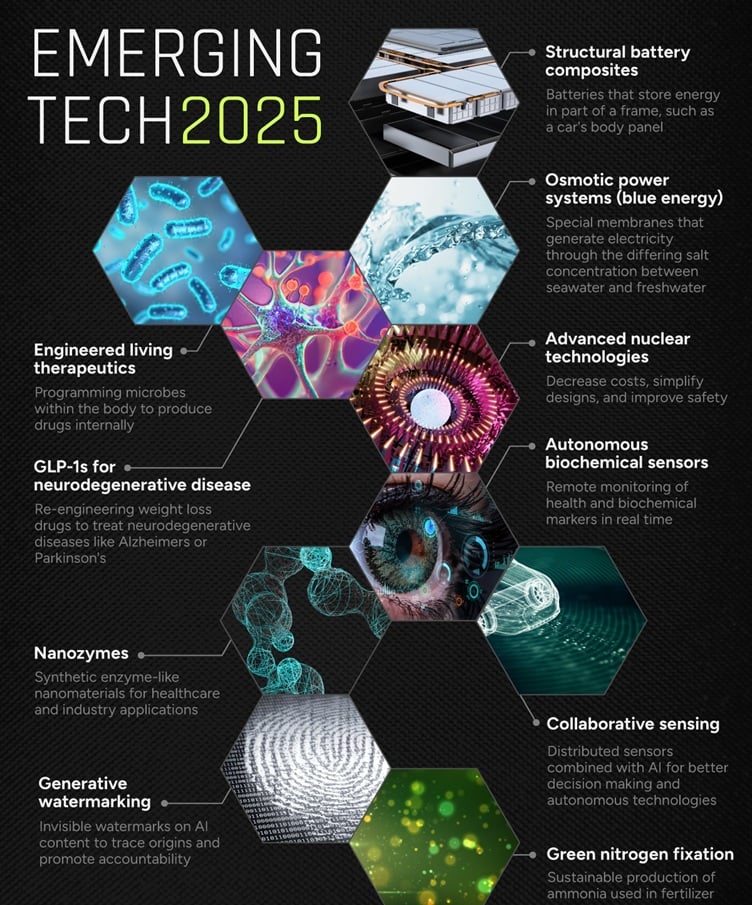
A survey of current breakthrough technologies conducted by the World Economic Forum positions health, sustainability and urban resilience as top priorities. Technologies such as collaborative sensing, autonomous biochemical sensing and green nitrogen fixation demonstrate ongoing innovation in these fields where urgent challenges persist. They also signal growing momentum to develop scalable solutions to chronic disease, environmental impact and infrastructure.
In the realm of health care, engineered living therapeutics offer a radical new approach: using programmed microbes that can produce medicine within the body itself. Lab-made nanozymes could improve medical tests, clean up pollution and support safer manufacturing. In addition, advanced biochemical sensors can wirelessly and autonomously monitor health or environmental changes.
Generative watermarking technology adds invisible tags to artificial intelligence-generated content, bolstering the fight against misinformation and strengthening trust online.
In the power sector, small modular reactors and other advanced nuclear technologies are gaining momentum as scalable, safe sources of clean energy while osmotic power systems offer a promising source of steady, low-impact power in coastal areas. Battery performance is improved with new materials that store energy and support weight, providing the opportunity to make electric vehicles lighter and more efficient.
