

The integration of artificial intelligence (AI) into satellite communication (SATCOM) systems marks a major turning point in the transmission of data, voice and video via Earth orbiting satellites. This integration encompasses the technology, infrastructure and services essential for satellite operation, alongside the development of ground-based equipment and antennas that support two-way communication between satellite systems and users.
SATCOM serves a broad range of applications including telecommunications, broadcasting, defense, emergency services, maritime, aviation and enterprise networks. It plays a critical role in providing global connectivity, especially in remote or underserved regions where terrestrial networks are impractical or unavailable.
The SATCOM industry faces significant challenges, driven by the need for high-capacity data transmission, low-latency communication and network reliability. The adoption of AI is pivotal in boosting the performance, flexibility and cost-effectiveness of these systems. As global demand for data connectivity grows, particularly with the rise of Internet of Things (IoT) devices, significant expansion and innovation are expected in 2024 and beyond.
- By 2025, nearly 50% of SATCOM operators will have implemented AI-driven automation in their network operations.
- AI-related investments in the broader telecommunications and satellite industries are expected to contribute to the global AI spending of $500 billion by 2027. Much of this will be dedicated to AI tools that enhance satellite communication efficiencies and manage the vast amounts of data generated by satellite systems.
- SATCOM operators using AI-based predictive maintenance are projected to see a 30% reduction in downtime by 2025. AI will enable real-time monitoring and prediction of satellite failures or environmental impacts, minimizing service interruptions.
- AI is expected to improve decision-making speeds in satellite network management by up to 70%, particularly in dynamic environments like maritime or aerospace, where quick adjustments are needed for optimal communication.
Background of AI use in SATCOM
Timely and reliable communication has become the backbone of modern commercial and governmental satellite networks. In recent years, the industry has focused on automating critical processes, with AI emerging as the most metamorphic technology.
The beauty of AI is that it can mimic human intelligence by analyzing vast amounts of data independently. This means swarms of devices throughout a network can share information and learn from each other’s experiences. This evolution enables satellite systems to move beyond human-dependent models, advancing into autonomous frameworks capable of managing complex networks with multiple satellite constellations across various orbits.
In particular, AI seems to have great potential in four key SATCOM applications.
- Dynamic beamforming: AI allows satellite systems to dynamically steer beams to areas of highest demand, optimizing power allocation and improving the quality of service.
- Network security: AI can continuously monitor network traffic to detect anomalous patterns that indicate cyberattacks or other malicious activities. The use of AI for real-time threat detection and response improves the overall security of SATCOM, making it a powerful resource for national security and enterprise operations.
- Multi-orbit optimization: With AI-driven orchestration, hybrid networks can intelligently route data through the most optimal orbit to ensure lower latency and higher resilience.
- Latency management: AI can also analyze and predict traffic congestion, and then reroute data to alternate paths.
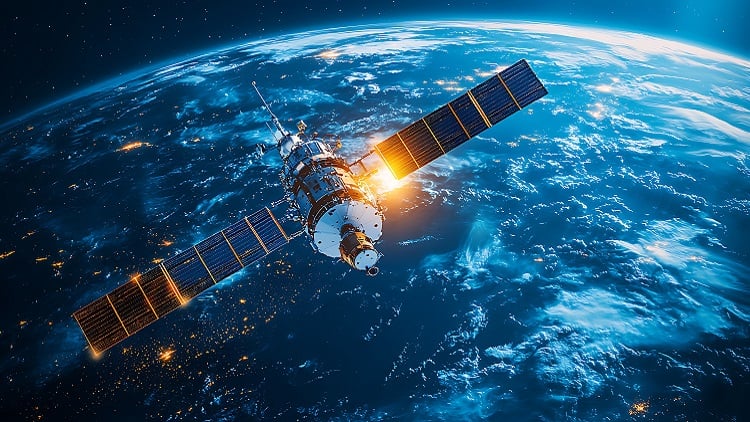 AI will be a critical enabler for SATCOM services as it grows beyond just use for military and corporate and into consumer realms. Source: SprintZz/Adobe Stock
Who will benefit?
For engineers, the proliferation of AI within SATCOM will drive significant shifts in both design and operational domains. AI will reduce the need for manual configuration and real-time decision-making, allowing engineers to focus on system-level launch and innovation.
- System design: Engineers will need to develop satellite systems that are AI-native, incorporating machine learning frameworks, edge computing capabilities and real-time analytics. AI-driven systems will require novel hardware architectures to support the additional computational load of real-time data processing in space and on the ground.
- Operational efficiency: AI’s ability to autonomously monitor and adjust system parameters will reduce the labor-intensive aspects of SATCOM maintenance, though engineers will need enhanced skills to manage the scalability of large satellite constellations.
- Cross-disciplinary collaboration: With the fusion of AI and SATCOM, there is a compelling argument for more collaboration between traditional satellite engineers and AI/machine learning specialists. Such interdisciplinary exchange will create opportunities for novel system designs, algorithms, and operational strategies.
For end users, the impact of AI integration in SATCOM will be felt in service quality and accessibility.
- Improved connectivity: As AI enhances resource allocation and beamforming, users will experience faster and more reliable internet connections, especially in remote or underserved regions where satellite connectivity is often the only viable option.
- Lower costs: The automation and optimization provided by AI will likely reduce operational costs for satellite operators. These cost reductions can trickle down to consumers, offering more affordable SATCOM services.
- Enhanced service quality: AI-driven network optimization will create reductions in buffering and remove delays in video streaming, VoIP calls and other bandwidth-intensive applications. Users will experience smoother, more responsive services regardless of their location.
- Resilience in disasters: AI will improve the ability of SATCOM networks to respond to environmental disruptions, especially natural disasters, when terrestrial networks may be compromised.
There is always a downside
AI's widespread use in SATCOM introduces critical technical challenges that must be addressed to achieve full system optimization. Cybersecurity risks, such as signal jamming and satellite takeovers, are heightened with AI-driven systems, requiring robust security protocols to ensure network integrity. Additionally, AI's current decision-making capabilities are limited when faced with unpredictable conditions like space weather or satellite malfunctions, necessitating more advanced models for greater adaptability.
Engineers must also contend with hardware constraints, as onboard satellites lack the computational power to run complex AI models. This leads to the need for energy-efficient processors like neuromorphic chips. Latency issues further complicate data transmission, driving the adoption of edge computing to enable real-time decision-making on satellites. Ensuring network resilience in multi-orbit constellations presents another challenge, as AI must autonomously reroute data and optimize traffic during disruptions. Finally, advances in autonomous capabilities, particularly in robotic sensing and satellite docking, are vital in order to achieve full AI integration in SATCOM systems.
Novel applications
Already, AI is changing the way global satellite operators process data, turning the sector into a more powerful and profitable hub of innovation. By providing novel solutions to long-standing challenges, AI is reshaping the industry and driving efficiency. Its advanced capabilities enable faster and more accurate data processing, setting new standards for how we monitor and understand the planet.
Weather forecasting: satellite technology and AI are improving cloud detection and weather forecasting by filtering out unusable, cloud-obstructed images directly in orbit. Φsat-2, developed by KP Labs, classifies clouds and transmits only clear data, enhancing meteorological models. This integration of AI with precise cloud detection allows for more accurate weather forecasts by analyzing biomes and atmospheric conditions in real time.
Natural disaster monitoring: Satellite technology, enhanced by machine learning, is advancing both wildfire detection and broader natural disaster monitoring. Thales Alenia Space's wildfire detection system provides real-time classification reports, helping firefighters locate fires, track their spread and identify hazards. Similarly, satellites capture early images of tornadoes, hurricanes and other disasters, enabling rapid assessments of severity and aiding in evacuation and response efforts.
Maritime and marine exploration: AI is being used by satellites to transform maritime vessels and marine anomaly detection, enhancing both security and environmental conservation. CEiiA's maritime vessel detection system automatically identifies and classifies vessels in specific regions, aiding in the monitoring of activities like illegal fishing. Meanwhile, IRT Saint Exupery's marine anomaly detection application identifies real-time threats to marine ecosystems, such as oil spills and harmful algae blooms, through advanced machine learning algorithms, supporting both environmental monitoring and response efforts.
Urban planning and map generation: AI integration with SATCOM is benefitting both urban development and emergency response capabilities. Satellites analyze urban sprawl and identify optimal zones for new development, guiding planners in sustainable land use. Meanwhile, the Sat2Map application, developed by CGI, converts satellite imagery into street maps, aiding emergency teams by identifying accessible roads during disasters like floods or earthquakes.
Conclusion
AI integration in the SATCOM ecosystem has a multiplicity of benefits, from enhanced network optimization and predictive maintenance to improved interference mitigation. AI is pushing SATCOM toward more autonomous, efficient and resilient systems. There will be significant benefits to end users, particularly in underserved regions and enterprises, by delivering improved connectivity, lower costs and enhanced service quality.
For engineers, this evolution presents both a challenge and an opportunity, requiring innovation, adaptation and cross-disciplinary collaboration to design AI-native systems capable of meeting these demands.
To unlock AI's full potential in SATCOM, engineers must address critical technical challenges such as cybersecurity risks, hardware limitations and the development of autonomous capabilities. These innovations will not only ensure the resilience and efficiency of SATCOM systems but also drive the industry forward in a data-driven world.
