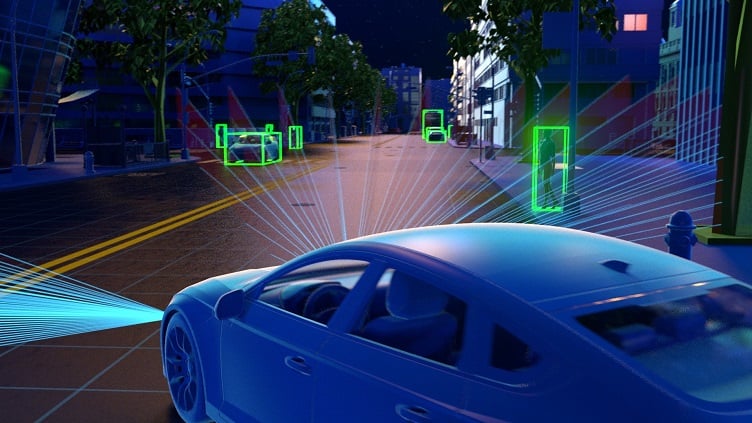
Researchers at Korea’s Icheon National University (INU) have developed a new object detection system for autonomous vehicles using internet of things (IoT)-based deep learning for a 3D recognition system that works even in unfavorable conditions.
While autonomous vehicles remain in their nascent stage even after several large companies have tested the technology on open roads. To get to mass circulation, these vehicles will need sophisticated object detection systems to navigate traffic, avoid obstacles and safely ensure the wellbeing of pedestrians, other drivers and other life on the road.
Autonomous vehicles could eventually be a key to unclogging traffic, enabling vehicle-to-vehicle (V2V) communication and a better travel experience. Additionally, these vehicles being electric could help climate change.
YOLOv3
The detection system, called you only look once (YOLOv3) is a deep learning object detection technique that uses point cloud data and RGB images as input. The system generates bounding boxes with confidence scores and labels for visible obstacles as output.
“Our proposed system operates in real time, enhancing the object detection capabilities of autonomous vehicles, making navigation through traffic smoother and safer,” said Gwanggil Jeon, a professor in the department of embedded systems engineering at INU.
To test the system, INU conducted experiments using the Lyft dataset to capture data from 20 autonomous vehicles traveling a predetermined route in Palo Alto, California, during a four-month period. VOLOv3 was found to have a high-level accuracy for 2D and 3D object detection of 96% and 97%, respectively.
The system even works in harsh conditions, something that current offerings for 3D object detection — like lidar or radar combined with cameras and a 360-degree field of view — struggle with, INU said.
The next steps
The current work is on autonomous vehicles but it could drive various other technological sectors like sensors, robotics and artificial intelligence.
The next steps are to explore additional deep learning algorithms for 3D object detection.
"By improving detection capabilities, this system could propel autonomous vehicles into the mainstream,” Jeon said. “The introduction of autonomous vehicles has the potential to transform the transportation and logistics industry, offering economic benefits through reduced dependence on human drivers and the introduction of more efficient transportation methods."
The full research can be found in the journal IEEE Xplore.
