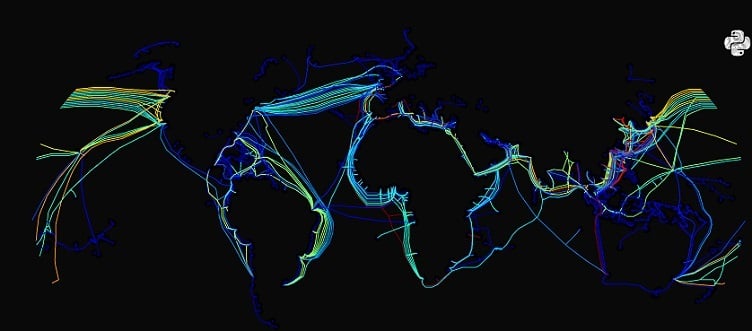
 Source: TeleGeography
In 1856 the Atlantic Telegraph Company completed the first trans-Atlantic submarine telegraph cable. The relatively simple system was composed of seven copper conductor wires, wrapped with three coats of rubber, all encased in tarred hemp and an 18-strand helical sheath of iron wires.
Subsea cable technology has evolved to become a prime mover in data connectivity, and currently accounts for 95% of international data transmission. Nearly 1.4 million km (0.9 million miles) of submarine cables are currently estimated to be in service globally, linking data centers and facilitating worldwide communication.
As the map above shows, there are 552 active and planned submarine cables. Submarine cables harness fiber-optic technology, transmitting information via rapid light pulses through glass fibers. These fibers, thinner than human hair, are protected by plastic or steel wire layers. Coastal cables are buried under the seabed, hidden from view on the beach, while deep-sea lines rest on the ocean floor.
Length varies from the 131 km CeltixConnect cable linking Dublin, Ireland, and Holyhead, U.K., to the 20,000 km Asia America Gateway cable connecting San Luis Obispo, California, to Hawaii and Southeast Asia.
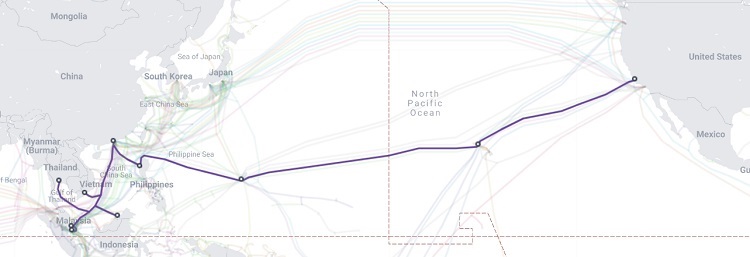 Asia America Gateway. Source: TeleGeography
Investment in submarine cables could reach $10 billion over the next two years, as telecoms providers and technology companies seek to increase capacity for global data traffic.
Stay connected: Subscribe to the Wire & Cable Technology newsletter from GlobalSpec.
