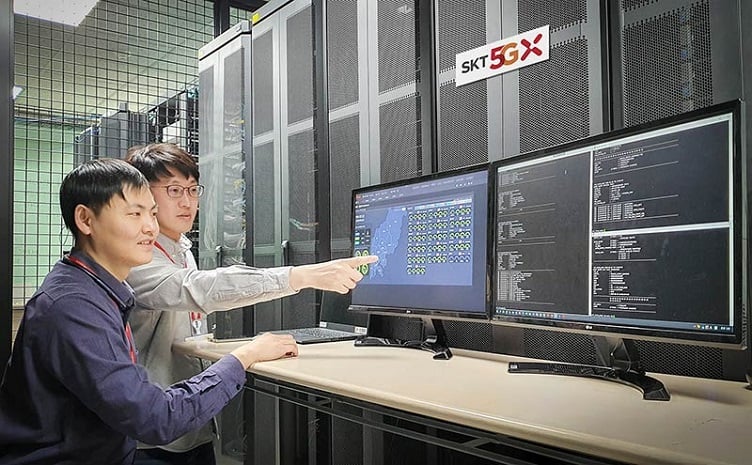
SK Telecom has successfully completed what it claims is the world’s first standalone (SA) 5G data session on its commercial 5G network.
The test allows SK Telecom to provide SA 5G services, which it plans to launch in the first half of 2020.
The call took place last week in Busan, South Korea, the second largest city in the country, using SK Telecom’s commercial 5G network deployed in the region.
The company applied its standalone new radio (NR) software to its existing non-standalone (NSA) 5G base stations and completed multi-vendor interoperability between network equipment from Ericsson and Samsung.
Non-standalone 5G technology piggybacks on 4G technology using the same base stations and equipment but providing higher speeds. Standalone service reportedly enables super-fast speeds to become a reality using 5G as it uses equipment specifically designed to support 5G without any dual connections needed.
“With the successful standalone 5G data call on our multi-vendor commercial 5G network, we are now standing on the threshold of launching standalone 5G service, a key enabler of revolutionary changes and innovations in all industries,” said Park Jong-kwan, vice president and head of 5GX Labs of SK Telecom.
The company said it has also applied key 5G technologies such as network slicing and mobile edge computing (MEC) to the standalone network. Network slicing is an important technology for providing optimal support for different types of 5G services by partitioning a single physical network into multiple virtual mobile networks. Meanwhile, MEC minimizes latency by proving a shortcut for data transmission through installation of small-scale data centers at 5G base stations or routers. MEC is something that can help with ultra-low latency 5G services such as cloud gaming, smart factory and self-driving cars.
Numerous companies have been testing both non-standalone and SA 5G connections over the past year including Ericsson and Qualcomm, which completed its standalone data connection in September 2019.
