
The complex visual system of the mantis shrimp has inspired a new camera design that could enhance the ability of cars to spot hazards in challenging imaging conditions.
The high dynamic range — a measure of the brightest and darkest areas a camera can capture simultaneously — of the system makes it easier to detect objects that are similar to the background. With a dynamic range about 10,000 times higher than commercial cameras, the polarization device can see better in driving conditions such as the transition from a dark tunnel into bright sunlight or during hazy or foggy conditions.
The new camera would enable cars to detect hazards, other cars and people three times farther away than color cameras used on cars today. Additional applications could include the detection of cancerous cells, 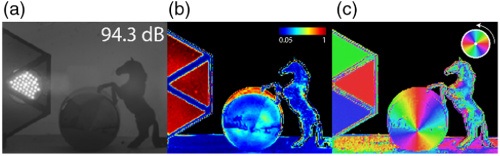 The dynamic range and polarization capability can be seen in the light intensity image (left) and two polarization images (middle and right) acquired with the new camera. The scene imaged included a black plastic horse, an LED flashlight and a cone-shaped piece of silicon. Source: Viktor Gruev, University of Illinois at Urbana-Champaignwhich exhibit a different light polarization than normal tissue, and to improve ocean exploration.
Their logarithmic response to light intensity makes mantis shrimp sensitive to a high range of light intensities, allowing them to perceive very dark and very bright elements within a single scene. To replicate this functionality, researchers operated the camera’s photodiodes in forward instead of the reverse bias mode conventionally used for imaging. This modification changed the electrical current output from being linearly proportional to the light input to having a logarithmic response like the shrimp.
The way that the mantis shrimp integrates polarized light detection into its photoreceptors was mimicked by depositing nanomaterials directly onto the surface of the imaging chip that contained the forward-biased photodiodes. These materials function as polarization filters at the pixel level and detect polarization in the same way as the shrimp.
The researchers are collaborating with an airbag manufacturing company to see if the new camera’s high dynamic range and polarization imaging capability can be used to better detect objects to either avert a collision or deploy the airbag a few milliseconds earlier than is currently possible.
The research conducted by University of Illinois at Urbana-Champaign and Washington University in St. Louis scientists is published in Optica.
