
New Yorker Electronics has released two new high resolution automotive grade digital proximity sensors with I2C interface from Vishay with high resolution up to 20 µm for force sensing applications.
With selectable 12 bit and 16 bit outputs, they are ideal for force sensing applications in steering wheel controls, laptop smart power buttons and multi-force trackpads, and touchpads for internet of things devices 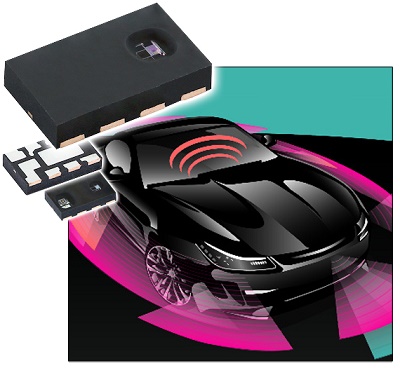 Source: New Yorker Electronicsand kitchen appliances. They each combine a photodiode, amplifier and analog-digital converter circuitry in a 4 mm by 2.36 mm surface-mount package with a low 0.75 mm profile. The VCNL3030X01 features an on-board infrared emitter (IRED) while the VCNL3036X01 is designed to be used with up to three external IREDs, for which an onboard driver with internal logic is provided. A smart persistence scheme ensures accurate sensing and faster response time.
The Vishay VCNL3030X01 integrates a proximity sensor and a high power IRED into one small package. The Vishay VCNL3036X01 integrates a proximity sensor, a mux and a driver for up to three external IREDs, also into a small package. Both types incorporate photodiodes, amplifiers and analog-to-digital converting circuits into a single chip by complementary metal-oxide semiconductor process. The proximity sensor offers a programmable interrupt with individual high and low thresholds with the power savings on the microcontroller.
The VCNL3030X01 and VCNL3036X01 both prevent false triggers while providing higher resolution compared to previous-generation sensors. A programmable interrupt function allows designers to specify high and low thresholds to reduce the continuous communication with the microcontroller, while its intelligent cancellation eliminates cross-talk. For force sensing applications, the sensors offer the flexibility to fine-tune the current for short displacements. They operate normally even when the user is wearing gloves.
